


A tablet press machine is a core piece of equipment in solid oral dosage manufacturing. Its main task is to convert prepared powder or granules into tablets with controlled weight, shape, thickness, and mechanical strength.
Although the tablet press machine performs the compression stage, tablet production is not simply a matter of applying pressure to powder. Material preparation, feeding, die filling, compression, ejection, discharge, and subsequent processing all affect the final result. A tablet press machine must therefore operate within a controlled process rather than work as an isolated unit.
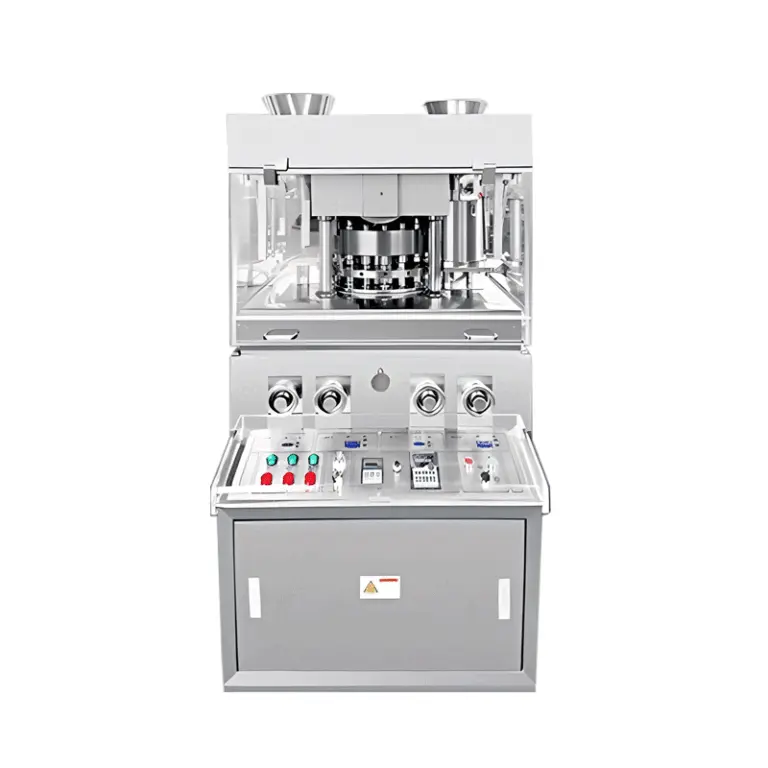
How Does a Tablet Press Machine Work
The working principle of a tablet press machine is based on controlled die filling followed by mechanical compression. Powder or granules enter the feeding area and are guided into die cavities. The lower punch determines the available filling space, while the amount of material entering each die influences tablet weight.
As the tooling moves through the tablet press machine, the punches enter the compression zone. The upper and lower punches move toward each other, reducing the powder bed volume and increasing material density. Under suitable pressure, particles rearrange, deform, and bond to form a coherent tablet.
After compression, the lower punch rises and pushes the finished tablet out of the die. The tablet then moves toward the discharge section, completing the basic compression cycle.
A tablet compression machine may perform these actions continuously in a rotary configuration or individually in a single-punch configuration. The operating principle remains based on the same fundamental sequence: filling, compression, ejection, and discharge.
What Is the Complete Tablet Press Machine Process
A complete tablet press machine process begins before powder reaches the compression chamber. The formulation normally needs to have suitable flow and compression characteristics. Depending on the product, materials may undergo weighing, blending, granulation, drying, sizing, and lubrication before entering the tablet press machine.
The basic production sequence can be described as:
- Prepare and condition the formulation.
- Transfer the material to the tablet press machine.
- Feed powder or granules into the die cavities.
- Control the filling volume and tablet weight.
- Apply pre-compression when required.
- Apply main compression to form the tablet.
- Eject the compressed tablet.
- Discharge the tablets for subsequent processing.
The exact process depends on the formulation, tablet specifications, tooling design, and equipment configuration. In pharmaceutical manufacturing, process conditions should be defined and controlled through appropriate procedures and quality systems. WHO GMP principles emphasize that pharmaceutical production processes should be clearly defined, controlled, documented, and supported by suitable equipment.
What Are the Core Actions of a Tablet Press Machine
The most important actions inside a tablet press machine are feeding, filling, compression, and ejection. Each action has a direct relationship with tablet quality.
Feeding and Die Filling in a Tablet Press Machine
The feeding system delivers powder or granules toward the dies. Uniform material flow is important because inconsistent filling can cause variation in tablet weight.
During die filling, the lower punch moves to establish the required cavity volume. In a single punch tablet press machine, this filling action takes place within an individual die cavity during each compression cycle. The tablet press machine then controls how much material enters the die. Factors such as powder flowability, particle size, bulk density, moisture, and feeder design can influence filling behavior.
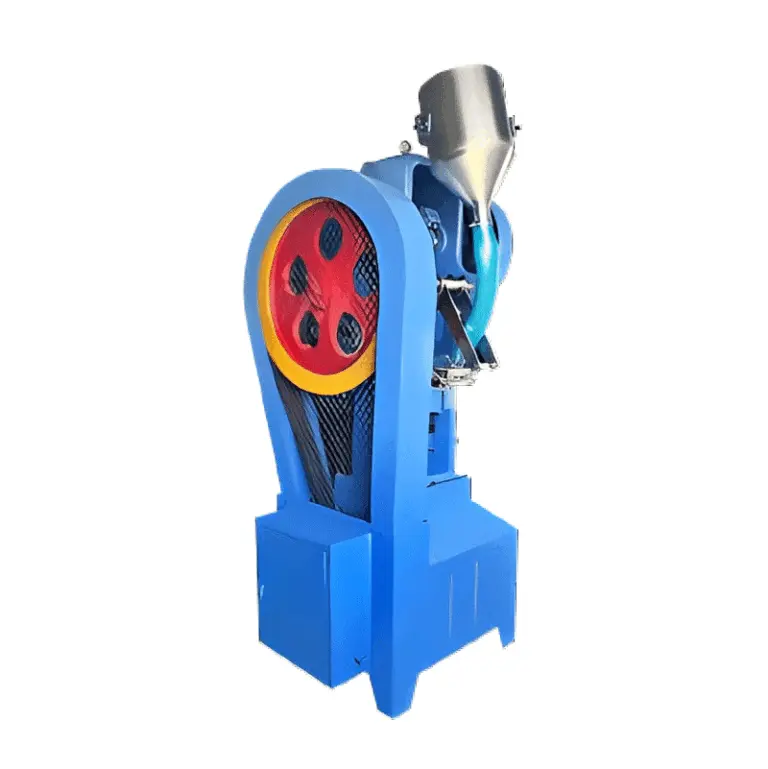
Compression in a Tablet Press Machine
Compression is the central action of a tablet press machine. The upper punch moves downward while the lower punch provides support from below. The material is compressed between the punches inside the die.
Some tablet press machine configurations use pre-compression before the main compression stage. Pre-compression can help remove entrapped air and prepare the powder bed for the main compression force.
The main compression stage then increases the density and mechanical integrity of the tablet. However, higher compression force does not automatically mean better tablets. The appropriate operating range depends on the formulation, tooling, tablet dimensions, and validated process conditions.
Ejection and Discharge from a Tablet Press Machine
After compression, the lower punch rises to eject the tablet from the die. The tablet press machine then guides the formed tablet toward the discharge area.
Smooth ejection is important because excessive friction or unsuitable tooling conditions can damage tablet edges or surfaces. After discharge, tablets may proceed to dedusting, inspection, metal detection, coating, or packaging, depending on the production process.
| Stage | Main Action | Purpose |
|---|---|---|
| Feeding | Material enters the feeder | Maintain material supply |
| Die filling | Powder enters each die | Establish tablet weight |
| Pre-compression | Initial force is applied | Consolidate the powder bed |
| Main compression | Higher force forms the tablet | Develop tablet integrity |
| Ejection | Lower punch rises | Remove the tablet |
| Discharge | Tablet leaves the machine | Transfer product to the next stage |
These stages form the basic mechanical cycle of a tablet press machine. Actual machine configuration can differ according to production capacity, tooling arrangement, formulation characteristics, and product requirements.
What Types of Tablet Press Machine Are Used
Different tablet press machine configurations are available for different production purposes.
A single-punch tablet press machine is commonly associated with small-scale production, laboratory development, formulation trials, and educational or testing applications. It forms tablets through an individual compression cycle and generally has a simpler mechanical structure.
A rotary tablet press machine uses multiple punch-and-die stations mounted around a rotating turret. As the turret rotates, different stations move through filling, compression, and ejection positions. This configuration is commonly used when continuous and higher-volume tablet production is required.
The selection of a tablet press machine should therefore be based on the intended application rather than production speed alone.
Typical considerations include:
- Tablet size and shape
- Formulation characteristics
- Required production capacity
- Compression-force range
- Tooling configuration
- Cleaning and maintenance requirements
- Process monitoring and control
- Production environment
How Does a Tablet Press Machine Fit Into Pharmaceutical Manufacturing
A tablet press machine is one part of a larger pharmaceutical manufacturing process. It does not normally prepare raw materials, perform final inspection, or package finished products by itself.
A typical solid dosage process may follow this general path:
Material preparation → blending or granulation → tablet press machine → dedusting → inspection → coating or packaging
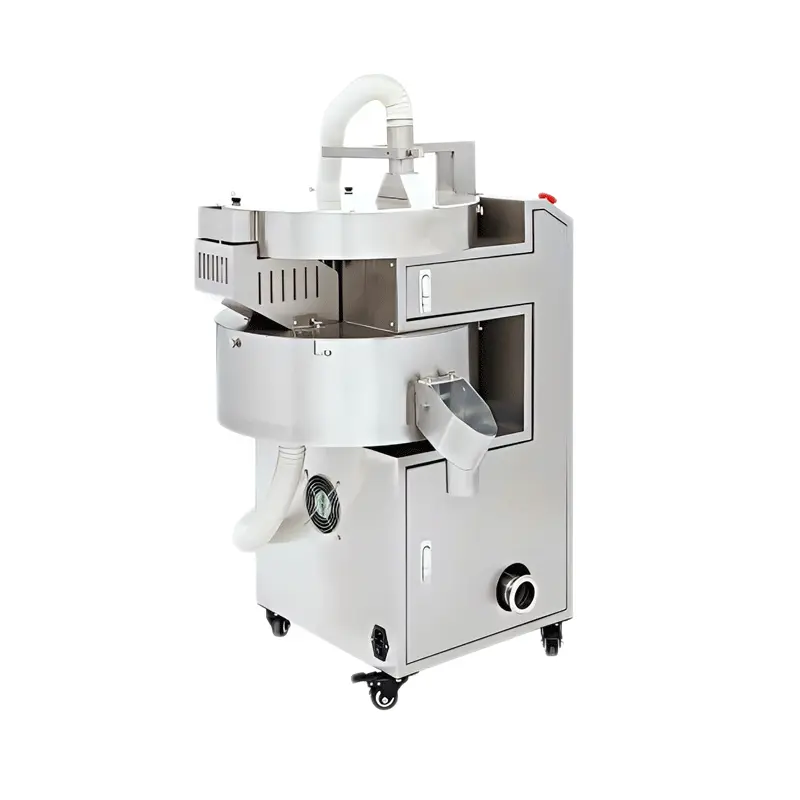
This distinction is important when purchasing equipment. A tablet press machine should be evaluated as a compression unit within a controlled manufacturing system, while supporting equipment such as a capsule polisher may be used for capsule processing in other solid dosage manufacturing applications.
WHO guidance describes pharmaceutical production as a series of controlled operations covering activities such as material handling, processing, packaging, and completion. GMP principles also emphasize suitable equipment, qualification, validation, and documented procedures.
What Affects Tablet Press Machine Performance
The performance of a tablet press machine depends on both equipment parameters and material properties. Powder flow, particle size distribution, moisture, lubrication, density, and compressibility can affect die filling and compression behavior.
Machine settings also matter. Turret speed, filling depth, compression force, tooling condition, and feeder performance can influence tablet weight, thickness, hardness, appearance, and production stability.
For pharmaceutical production, the tablet press machine should operate within established and validated process conditions. Equipment qualification and validation provide documented evidence that equipment and processes can perform as intended.
FAQ
What is the main function of a tablet press machine?
A tablet press machine compresses prepared powder or granules into tablets with controlled physical characteristics.
What are the main actions of a tablet press machine?
The basic actions are feeding, die filling, compression, ejection, and discharge.
Which tablet press machine is suitable for small-scale production?
A single-punch tablet press machine is commonly used for laboratory work, formulation development, testing, and other small-scale applications, while rotary equipment is generally suited to continuous higher-volume production.