


Filling powder accurately is one of the trickier challenges in pharmaceutical production. Unlike liquids, powders don’t flow predictably. They clump, bridge, absorb moisture, and carry static charge—all of which threaten dose accuracy. Choosing the right pharmaceutical powder filling machine means understanding how your powder behaves and matching it to the correct dosing technology.
Two methods dominate the market: auger (screw) dosing and vacuum (dosator) dosing. Each excels with certain powder types. This guide compares the two principles, explains how powder properties affect filling precision, and offers a quick selection chart to speed your decision.
How Auger Dosing Works
How Vacuum Dosing Works
Vacuum dosing, also called dosator filling, draws powder into a dosing chamber using suction. A vacuum pulls powder into a precisely sized cavity, then the powder is released into the container—often by reversing the vacuum or applying gentle pressure. Because the dose depends on a fixed chamber volume, this method delivers excellent consistency, particularly with fine or difficult powders.
Vacuum systems also offer superior dust containment, which matters when handling potent or hazardous compounds.
Comparing the Two Technologies
| Factor | Auger Dosing | Vacuum Dosing |
|---|---|---|
Best-suited powders | Free-flowing to moderate | Fine, cohesive, or dusty |
Accuracy | Good | Very good |
Speed | High | Moderate to high |
Dust containment | Moderate | Excellent |
Fill weight range | Wide | Moderate |
Cleaning complexity | Moderate | Higher |
How Powder Properties Affect Filling Accuracy
Flowability
Flowability is the single most influential factor. Free-flowing powders move consistently through an auger, making screw dosing accurate and fast. Cohesive or sticky powders, however, resist flowing and tend to bridge—here, vacuum dosing usually performs better because it actively draws powder into the chamber.
Particle Size
Particle size and distribution affect how powder packs and flows. Very fine powders behave cohesively and can be difficult for auger systems, favoring vacuum dosing. Coarser, granular powders generally flow well through augers. Consistent particle size improves accuracy regardless of method, directly reducing filling defects that would create complications for the downstream packaging machine.
Static Charge
Fine powders often develop static electricity, causing them to cling to equipment surfaces and dose inconsistently. Static control measures—such as ionization, grounding, and controlled humidity—help maintain accuracy. Powders prone to heavy static charging often perform more reliably in enclosed vacuum systems.
Here are the key questions to ask about your powder before selecting equipment:
How freely does the powder flow?
What is the particle size and distribution?
Is the powder hygroscopic or moisture-sensitive?
Does it develop static charge easily?
Is it potent, requiring containment?
Quick Selection Guide
Use this ordered approach to narrow your choice efficiently:
Assess flowability — Good flow leans toward auger; poor flow leans toward vacuum.
Check particle size — Coarse favors auger; very fine favors vacuum.
Evaluate static and dust risk — High risk favors enclosed vacuum systems.
Consider containment needs — Potent compounds favor vacuum for operator safety.
Match to output requirements — High speed with easy powders favors auger.
For many applications, a pharmaceutical powder filling machine using auger dosing offers the best balance of speed, flexibility, and cost. For fine, cohesive, or hazardous powders, vacuum dosing is often the smarter investment.
A Note on Sachet Filling
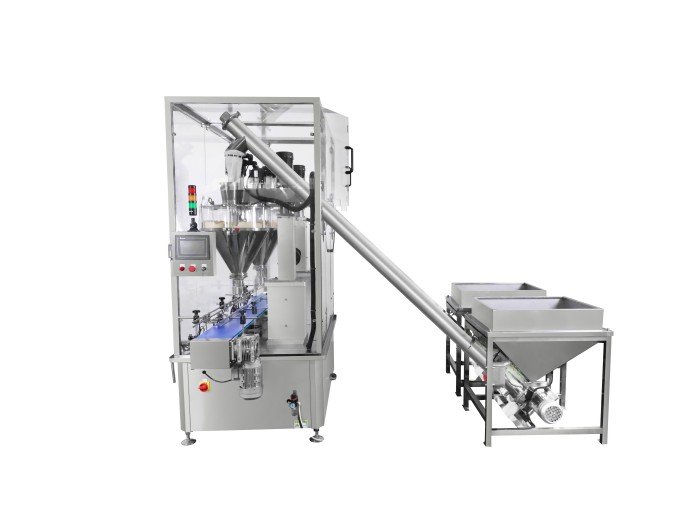
Not all powder ends up in vials or bottles. Single-dose sachets are increasingly popular for oral powders and effervescent products. As core pharmaceutical industry machines for small-powder packaging, a pharmaceutical sachet filling machine typically uses auger dosing to fill and seal individual sachets in a continuous cycle, combining accurate dosing with form-fill-seal packaging. The same powder-property principles apply across these pharmaceutical industry production machines: flowability, particle size, and static all influence which dosing configuration performs best.
Conclusion
Matching your dosing technology to your powder is the key to accurate, compliant filling. Auger dosing suits free-flowing powders and high speeds, while vacuum dosing excels with fine, cohesive, and dusty materials that demand tight tolerance and strong containment. By assessing flowability, particle size, and static charge, then applying the quick selection guide, you can confidently choose the right pharmaceutical powder filling machine for your product—and ensure consistent quality batch after batch.
FAQ
Which is more accurate, auger or vacuum dosing?
Both can be highly accurate. Auger dosing performs excellently with free-flowing powders, while vacuum dosing typically achieves tighter consistency with fine or cohesive powders. The best accuracy comes from matching the method to your specific powder properties rather than assuming one is universally superior.
How do I control static during powder filling?
Use grounding, ionizing bars, and controlled environmental humidity to reduce static charge. Enclosed vacuum systems also help by limiting powder exposure. Managing static is especially important for fine powders, which cling to surfaces and cause dosing variation when charged.
Can a sachet filling machine handle the same powders as a vial filler?
Generally yes. A pharmaceutical sachet filling machine applies the same dosing principles—usually auger-based—so the same considerations of flowability, particle size, and static apply. The main difference is the packaging format: sachets are formed, filled, and sealed in one continuous operation rather than filled into pre-made containers.