


Capsules are among the most versatile oral dosage forms in modern medicine. They mask unpleasant tastes, protect sensitive ingredients, and allow precise dosing of powders, pellets, and granules. But producing consistent, compliant capsules at scale depends entirely on the equipment behind them. Selecting the right pharmaceutical capsule filling machine is therefore a decision that shapes your productivity, cost structure, and regulatory standing for years to come.
Yet buyers face a persistent question: should you invest in a semi-automatic machine or commit to a fully automatic system? And within each category, how do models such as the BJ-III, 200J-H, 400J-H, and 2000J-H actually differ in practice?
This guide answers those questions directly. We’ll explain the core dosing technologies—tamping pin versus dosator—and then evaluate four representative models across three practical axes: output capacity, cost, and compliance. By the end, you’ll have a clear, structured basis for matching a machine to your production reality.

Understanding How Capsule Filling Works
Before comparing models, it helps to understand what happens inside a capsule filling machine. Regardless of automation level, every machine performs a similar sequence of core functions.
The typical process unfolds in these stages:
Capsule loading — Empty two-piece capsules are fed into the machine and oriented cap-up.
Separation — The cap and body are separated so the body can be filled.
Dosing — The fill material (usually powder) is measured and dispensed into the body.
Rejoining — The cap is placed back onto the filled body and locked into position.
Ejection — The completed capsule is discharged, and empty stations are cleared for the next cycle.
The heart of this process is the dosing stage, and here two distinct technologies dominate the market. Understanding their differences is essential to choosing the right pharmaceutical capsule filling machine.
Tamping Pin vs Dosator: The Two Core Technologies
Fill accuracy and product suitability hinge largely on which dosing principle a machine uses. Both aim to deliver a precise, repeatable dose, but they achieve it in fundamentally different ways.
The Tamping Pin (Dosing Disc) Principle
The Dosator Principle
A dosator system works differently. A hollow dosing tube (the dosator) descends into a bed of powder maintained at a consistent depth. Inside the tube, a piston sets the dosing volume. As the dosator plunges into the powder bed, powder enters the tube and is lightly compressed to form a plug. The dosator then moves over the capsule body and the piston pushes the plug out. After filling, finished capsules may undergo sterilization treatment using equipment such as the industrial autoclave for specific sterile product requirements.
Dosator systems handle a broad range of powders and offer excellent dosing flexibility, making them common across intermittent-motion machines and many mid-range applications.
The table below summarizes the key contrasts:
| Feature | Tamping Pin | Dosator |
|---|---|---|
Dosing method | Multi-station compression in a disc | Single-plunge into powder bed |
Best suited to | Fine, free-flowing powders | Wide range, including cohesive powders |
Typical speed | Very high | Moderate to high |
Dose formation | Gradual, multi-step | Single compression |
Common use | High-speed continuous lines | Intermittent-motion machines |
Semi-Automatic vs Fully Automatic: The Fundamental Divide
Semi-Automatic Machines
Semi-automatic pharmaceutical capsule filling machines, essential pharmaceutical production machines, require operator involvement at several points—loading capsules, transferring trays between stations, and assisting with certain steps. They still automate the demanding tasks of separation and dosing, delivering good accuracy while keeping investment modest. These machines suit laboratories, pilot production, small batches, and manufacturers producing many different products in smaller quantities within the pharmaceutical industry. Their flexibility and lower cost make them an excellent entry point among pharmaceutical industry machines.
Fully Automatic Machines
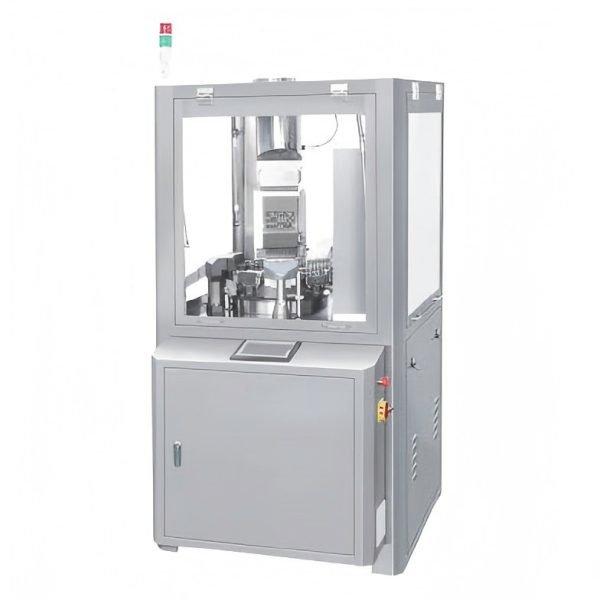
Fully automatic systems perform the entire cycle continuously without manual intervention between stages. Capsules feed automatically, dosing occurs at high speed, and finished capsules discharge in an uninterrupted flow. Many integrate weight checking, rejection of defective capsules, and dust extraction, and can be configured to connect with upstream processing equipment such as the freeze dryer for moisture-sensitive formulations.
These machines are built for commercial-scale production where consistent high volume and minimal labor are priorities.
Here is a quick way to think about which direction suits you:
Choose semi-automatic if you prioritize flexibility, run smaller batches, produce diverse products, or operate with a limited capital budget.
Choose fully automatic if you need high, consistent output, want to minimize labor costs per unit, and produce large volumes of relatively few products.
Comparing Four Representative Models
To make this concrete, let’s examine four models of pharmaceutical capsule filling machine that span the full range from entry-level semi-automatic to high-speed fully automatic. These designations—BJ-III, 200J-H, 400J-H, and 2000J-H—represent typical tiers of capacity and automation found across the pharmaceutical capsule filling machine market.
BJ-III: The Semi-Automatic Workhorse
The BJ-III represents the semi-automatic category. It automates capsule separation and dosing while relying on operators for loading and handling. This model is well suited to research settings, small-scale production, and manufacturers who value versatility over raw throughput.
Its strengths lie in affordability, a compact footprint, and the ability to switch products quickly. For businesses just entering capsule production or running frequent small batches, the BJ-III offers an accessible, reliable starting point.
200J-H: Entry-Level Full Automation
The 200J-H marks the transition into fully automatic operation. It handles the complete cycle continuously and typically incorporates automatic capsule feeding and dosing. This tier suits growing manufacturers who have outgrown semi-automatic equipment but do not yet require the highest speeds.
It delivers a meaningful jump in output and consistency while remaining more approachable in cost than top-tier machines.
400J-H: The Mid-Range Performer
The 400J-H sits in the productive middle of the range. It offers substantially higher throughput than entry-level automatic models, along with integrated features such as weight monitoring and reject stations. This model appeals to established manufacturers running steady commercial volumes who need dependable, higher-speed output.
2000J-H: High-Speed Commercial Production
At the top of the range, the 2000J-H is engineered for large-scale commercial manufacturing. It delivers very high output through continuous operation, typically using tamping pin dosing to achieve the required speed. Comprehensive automation, in-line quality checks, and dust containment make it suited to major production facilities where volume and consistency are paramount.
The comparison table below places these four models side by side across the three decision axes:
| Model | Automation Level | Relative Output | Relative Investment | Typical Use Case |
|---|---|---|---|---|
| BJ-III | Semi-automatic | Lowest | Lowest | R&D, small batches, diverse products |
| 200J-H | Fully automatic | Moderate | Moderate | Growing commercial production |
| 400J-H | Fully automatic | High | Higher | Steady mid-to-large volumes |
| 2000J-H | Fully automatic | Highest | Highest | Large-scale commercial output |
Evaluating Across the Three Axes
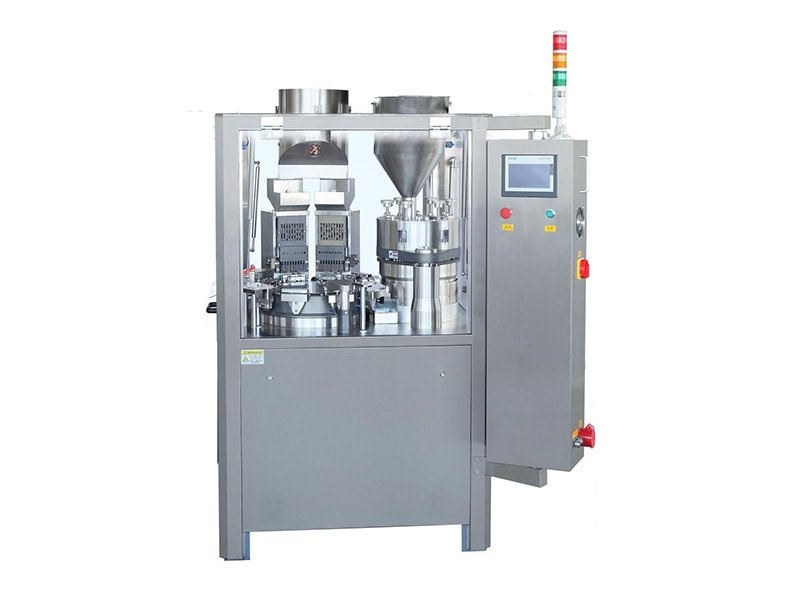
Output Capacity
Cost
Cost analysis must extend well beyond the purchase price. A comprehensive view of total cost of ownership includes several elements:
Initial equipment investment
Installation and validation
Labor requirements per shift
Energy consumption
Maintenance and spare parts
Expected service life
Downtime risk
A semi-automatic pharmaceutical capsule filling machine has a low purchase price but higher labor cost per capsule. A fully automatic pharmaceutical capsule filling machine costs more upfront yet dramatically reduces labor per unit at high volumes. The crossover point depends on your production scale. For high-volume producers, the labor savings of a 2000J-H can offset its higher price surprisingly quickly, while for low-volume operations the BJ-III remains the more economical choice overall.
Compliance
Compliance is where no compromise is acceptable. Every pharmaceutical capsule filling machine you consider must support Good Manufacturing Practice (GMP) requirements and align with the expectations of regulators such as the U.S. Food and Drug Administration (FDA) and the European Medicines Agency (EMA).
Key compliance features to verify include:
Contact parts made of pharmaceutical-grade stainless steel (typically 316L)
Smooth, cleanable surfaces with minimal dead zones
Complete validation documentation (IQ, OQ, PQ)
In-process weight verification for dosage uniformity
Dust containment to protect operators, especially with potent compounds
Ease of cleaning to prevent cross-contamination
Higher-tier automatic models more readily integrate in-line checkweighing and automatic rejection, which strengthen compliance with pharmacopoeial uniformity of dosage unit standards. For potent or narrow-therapeutic-index drugs, these features are particularly valuable.
A Practical Decision Path
To bring everything together, here is a simple way to work toward your answer:
Estimate realistic output needs for the next three to five years.
Assess your product mix—few products in high volume, or many products in smaller batches?
Determine your powder characteristics to decide between tamping pin and dosator dosing.
Calculate total cost of ownership, not just purchase price.
Confirm compliance requirements for your target markets.
Match the profile to the appropriate model tier.
A manufacturer producing large volumes of a stable, free-flowing powder for a single product will likely land on a tamping-pin 2000J-H. A contract manufacturer juggling many small orders will find the flexible BJ-III far more practical. Most growing businesses settle somewhere in between, with the 200J-H or 400J-H offering the right balance.
Conclusion
Selecting the right pharmaceutical capsule filling machine comes down to understanding two things clearly: how the dosing technology works, and how the available models map to your specific needs. Tamping pin and dosator systems each excel in different contexts, while the choice between semi-automatic and fully automatic hinges on your volume, budget, and labor strategy.
By evaluating the BJ-III, 200J-H, 400J-H, and 2000J-H across output, cost, and compliance, you replace guesswork with a structured decision. Whether you’re launching a modest capsule line or scaling toward high-volume commercial production, this framework helps you invest with confidence—and ensures your equipment supports quality, compliance, and growth for years to come.
FAQ
What is the main difference between tamping pin and dosator capsule filling?
Tamping pin systems build a powder plug through multiple gentle compressions within a rotating dosing disc, making them ideal for fine powders and very high speeds. Dosator systems form the dose in a single plunge into a powder bed, offering broad flexibility across different powder types. Your powder characteristics and required output determine the better fit.
When should I upgrade from a semi-automatic to a fully automatic machine?
Consider upgrading when your output demand consistently strains a semi-automatic machine, when labor costs per capsule become significant, or when you need tighter, automated quality control such as in-line weight checking. Growing manufacturers often move from a model like the BJ-III to a 200J-H or 400J-H as volumes rise and product ranges stabilize.
Do all these capsule filling machines meet GMP requirements?
Compliance depends on specifications and the supplier, not the model tier alone. Any machine you choose should feature pharmaceutical-grade stainless steel contact parts, cleanable surfaces, complete IQ/OQ/PQ documentation, and dust containment. Higher-tier automatic models more easily integrate in-line checkweighing and rejection, which support dosage uniformity compliance. Always confirm documentation with your equipment partner.