


Choosing a powder tablet press is not simply a matter of looking at the highest tablets-per-hour number on an equipment specification sheet. For pharmaceutical manufacturers, actual capacity depends on several interacting parameters, including the number of stations, turret speed, tablet configuration, powder feeding performance, compression cycle, and operating conditions.
A powder tablet press converts a controlled powder or granulated blend into tablets through die filling, compression, and ejection. FDA guidance describes tabletting as the compression of a powder blend to form a single unit dose, while tablet press subclasses can differ according to how the powder is delivered into the die cavity.
For customers comparing laboratory, pilot, and production equipment, understanding these parameters is essential. A small powder tablet press may be suitable for formulation development and process studies, while a larger powder tablet press can provide significantly higher output for commercial manufacturing. However, higher theoretical capacity does not automatically mean higher effective production.
This article explains the major powder tablet press capacity parameters and shows how to match equipment size with development, pilot-scale, and commercial production requirements.
Powder Tablet Press Capacity and Output Calculation
The capacity of a powder tablet press is commonly expressed as tablets per hour. At a basic level, theoretical output is related to the number of compression stations, turret rotation speed, and the number of tablets produced during each compression cycle.
A simplified calculation is:
Theoretical output = Number of stations × Turret speed × Tablets per station per revolution × 60
For example, if a powder tablet press has 20 stations and operates at 30 revolutions per minute, with one tablet produced at each station during each revolution, the theoretical output would be:
20 × 30 × 60 = 36,000 tablets per hour
This is a theoretical calculation rather than a guaranteed production rate. Actual output may be lower because of powder characteristics, machine adjustments, tooling configuration, compression requirements, in-process testing, rejects, stoppages, and other operating conditions.
FDA inspection guidance has highlighted the importance of establishing appropriate compression-machine speed and controlling compression parameters within validated operating ranges. Machine speed can also influence powder filling and tablet weight.
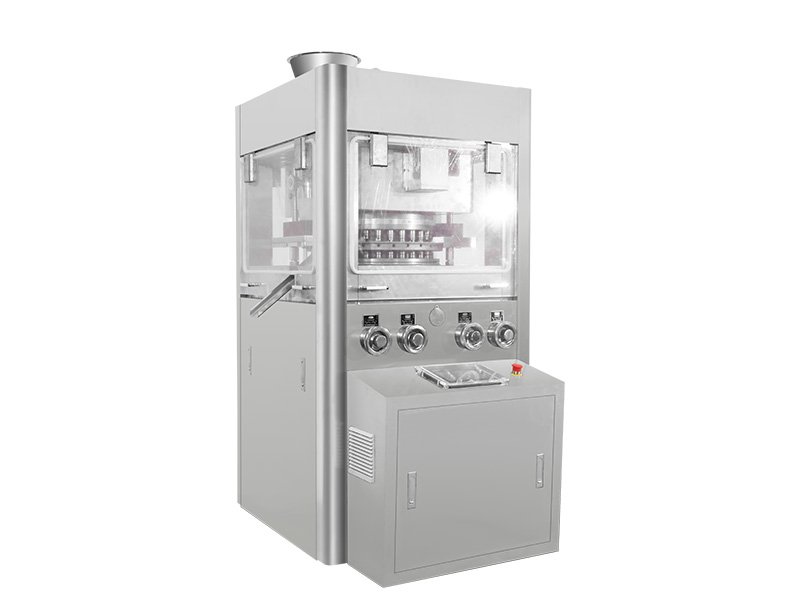
Powder Tablet Press Station Number
The number of stations is one of the most visible capacity parameters.
A powder tablet press with more stations can potentially produce more tablets per revolution because more dies are available for compression. This is one reason production-scale machines generally have substantially higher theoretical output than laboratory machines.
However, station count should not be considered independently. The actual production rate also depends on:
- Turret operating speed
- Number of tablet layers
- Tablet shape and size
- Compression profile
- Powder feeding characteristics
- Tooling configuration
- Required quality controls
A machine with a high station count may therefore have a lower effective output than its theoretical specification suggests if the formulation requires conservative operating conditions.
Powder Tablet Press Turret Speed
Turret speed determines how quickly the stations move through the filling and compression cycle. Increasing speed can increase theoretical capacity, but it can also change the behavior of the powder inside the feed system and die cavity.
FDA documentation notes that machine speed can affect die filling and tablet weight, making speed an important process parameter rather than simply a production-rate setting. Similar considerations apply to downstream equipment, such as a tablet coating machine, where operating speed can also influence process efficiency and product handling.
For this reason, customers should evaluate the validated operating range of a powder tablet press instead of selecting equipment solely according to its maximum revolutions per minute.
Powder Tablet Press Capacity Parameters That Affect Production
Several parameters work together to determine the usable capacity of a powder tablet press. Understanding each one helps customers distinguish between theoretical output and practical production capacity.
| Parameter | Capacity impact |
|---|---|
| Station number | More stations can increase output per revolution |
| Turret speed | Higher speed can increase theoretical output |
| Tablet configuration | Multi-layer or special tablets may reduce effective output |
| Powder flow | Poor flow can affect die filling and weight consistency |
| Compression force | Required force can influence operating conditions |
| Feeding system | Stable feeding supports consistent high-speed operation |
| Tablet rejection | Rejects reduce saleable output |
| Changeover time | Longer changeovers reduce available production time |
The relationship between these parameters is important. For example, a powder tablet press may be technically capable of operating at a high turret speed, but a formulation with poor flowability may require a lower speed to maintain consistent die filling.
Likewise, a tablet with a complicated shape or multi-layer structure may require different feeding and compression arrangements. FDA documentation identifies different tablet press subclasses, including gravity, power-assisted, centrifugal, and compression-coating approaches, as well as specialized configurations for micro/mini tablets and multilayer tablets.
Powder Tablet Press Theoretical Capacity vs Actual Capacity
One of the most important distinctions when evaluating a powder tablet press is the difference between theoretical and actual output.
Theoretical capacity assumes continuous operation under specified machine conditions. In real pharmaceutical manufacturing, the powder tablet press must also accommodate setup, sampling, inspection, cleaning, adjustments, and occasional interruptions.
Actual output can therefore be considered from three perspectives:
- Theoretical capacity: the calculated maximum output based on machine configuration and speed.
- Effective production capacity: the output achieved during normal operation after allowing for adjustments and routine interruptions.
- Saleable output: the number of acceptable tablets remaining after quality checks and rejected units are considered.
This distinction is particularly important when comparing equipment quotations. A supplier’s maximum output figure should be treated as a reference point rather than a guaranteed production result.
FDA cGMP guidance requires appropriate in-process controls and emphasizes checking actual yield against theoretical yield, with unexplained discrepancies requiring investigation. This principle can also be considered for upstream equipment such as an industrial pulverizer machine, where processing losses or material retention may affect the expected yield before the powder reaches the compression stage.
Powder Tablet Press Powder Flow and Feeding
Powder characteristics can have a direct effect on capacity. A formulation with stable flow properties can generally support more consistent die filling than a formulation that tends to bridge, segregate, or fluctuate in bulk density.
The feed system must deliver an appropriate amount of powder to each die cavity. If feeding becomes unstable at higher speeds, increasing the turret speed may create tablet-weight variation rather than useful additional production.
FDA guidance also emphasizes scientifically sound sampling of powder blends and recognizes within-location and between-location variability as relevant to finished-product quality.
Therefore, capacity testing should be performed with the actual formulation or a suitably representative material whenever possible.
Powder Tablet Press Small-Scale Capacity Analysis
Laboratory and small-scale equipment is mainly used during formulation development, feasibility studies, tooling trials, and process optimization.
A laboratory powder tablet press normally emphasizes flexibility, controllability, and small material consumption rather than maximum output. Its relatively low capacity allows researchers to test different formulations without consuming large quantities of active pharmaceutical ingredient or excipients.
Typical applications include:
- Initial tablet formulation development
- Compression-force studies
- Tooling evaluation
- Tablet size and shape trials
- Preliminary process optimization
- Small development batches
For development work, the most important capacity question is often not “How many tablets per hour can the machine produce?” but “Can the machine provide enough representative output for reliable process evaluation?”
A small powder tablet press may therefore be the appropriate choice when material availability is limited and the objective is to establish compression behavior before scale-up.
Powder Tablet Press Pilot-Scale Capacity Analysis
Pilot-scale equipment occupies the middle ground between laboratory development and commercial production.
A pilot powder tablet press is useful when manufacturers need larger batches for process verification, stability studies, clinical development, scale-up evaluation, or manufacturing-process optimization.
At this stage, capacity becomes more important because the equipment should generate enough material to represent production conditions without requiring a full commercial line.
| Scale | Main purpose | Capacity focus |
|---|---|---|
| Laboratory | Formulation development | Flexible, low-volume output |
| Pilot | Process development and scale-up | Representative intermediate output |
| Production | Commercial manufacturing | High sustained output |
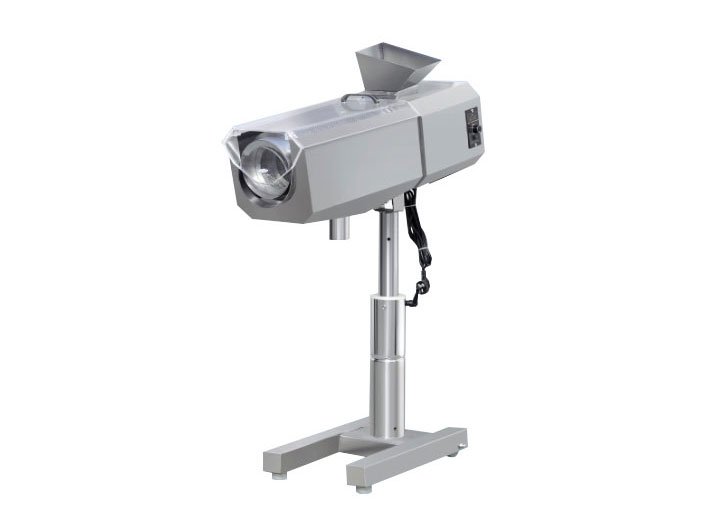
The pilot stage is especially important because scale-up can reveal differences that are not obvious during laboratory testing. Changes in powder feeding, compression speed, equipment geometry, and operating conditions can influence tablet quality. Downstream equipment, such as a tablet deduster, may also affect tablet handling and overall process efficiency during scale-up.
FDA inspection materials have documented cases where different tablet compression equipment and operating parameters affected process consistency, reinforcing the need to evaluate equipment capability during scale-up rather than assuming that laboratory results automatically transfer to production.
Powder Tablet Press Production Capacity for Commercial Manufacturing
A production powder tablet press is designed for sustained manufacturing output. Commercial equipment generally provides a greater number of stations, higher potential turret speeds, larger feeding capacity, and more robust systems for continuous operation.
However, the correct production machine should be selected according to the required batch size and annual demand rather than maximum machine output alone.
For example, suppose a manufacturer needs to produce 10 million tablets per month. A powder tablet press capable of producing several hundred thousand tablets per hour may provide sufficient theoretical capacity, but the actual requirement also depends on:
- Number of production shifts
- Working hours per shift
- Batch size
- Changeover frequency
- Cleaning time
- Planned maintenance
- Quality-control sampling
- Expected rejection rate
- Product mix
A manufacturer running multiple formulations may require more available production time because frequent changeovers can reduce effective capacity.
The goal is therefore to match equipment capacity with the complete manufacturing schedule rather than selecting the largest available machine.
Powder Tablet Press and Tablet Size Selection
Tablet size is another important capacity consideration.
A small tablet generally requires a different die and punch configuration from a large tablet. Tablet thickness, shape, embossing, and compression requirements can influence how the powder tablet press operates.
For multi-layer tablets, additional feeding and compression arrangements may be required. FDA’s equipment guidance specifically recognizes multi-layer and specialized tablet press configurations as distinct equipment applications.
Customers should therefore provide the following information when requesting capacity recommendations:
- Tablet diameter and thickness
- Target tablet weight
- Tablet shape
- Number of layers
- Required compression force
- Formulation characteristics
- Target batch size
- Required annual production
- Expected operating hours
This information gives the equipment supplier a more reliable basis for determining the suitable powder tablet press configuration.
Powder Tablet Press Capacity and Industrial Production Planning
An industrial tablet press should be evaluated as part of the complete manufacturing process.
The powder tablet press is normally connected with upstream powder preparation and downstream tablet handling equipment. If another process step has a lower capacity, increasing tablet press output alone will not necessarily increase total line capacity.
For example, if powder preparation supplies material more slowly than the compression process consumes it, the powder tablet press may need to operate below its maximum capacity. Likewise, downstream inspection, dedusting, coating, or packaging can become a bottleneck.
FDA cGMP requirements emphasize that manufacturing equipment must be suitable for its intended use and that process controls should ensure consistent production.
Capacity planning should therefore consider the complete production flow.
Powder Tablet Press Capacity and Quality Control
Capacity should never be separated from tablet quality.
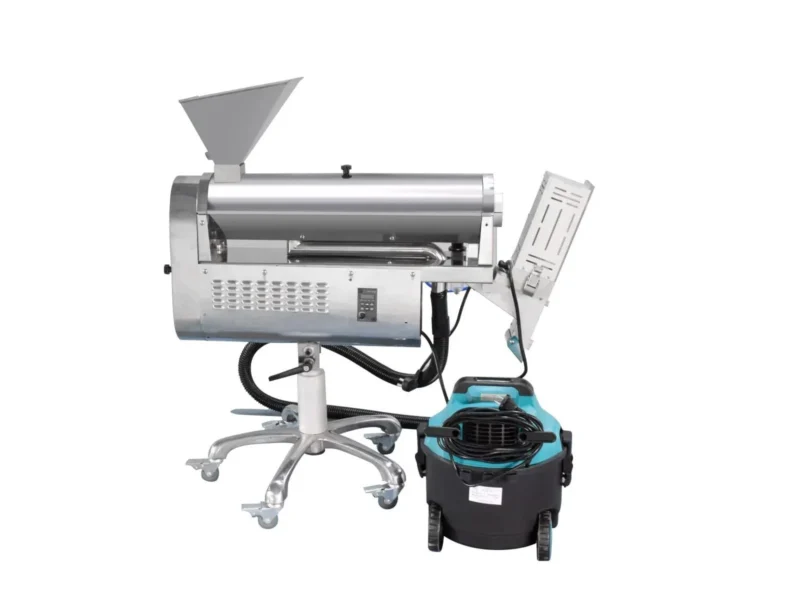
Increasing the speed of a powder tablet press may increase theoretical output, but the resulting tablets must still meet established specifications for attributes such as weight, thickness, hardness, friability, and disintegration where applicable. Similar quality considerations apply to downstream equipment, such as a capsule polisher machine, where effective operation can help maintain consistent product handling and processing efficiency.
FDA inspection guidance identifies tablet weight, thickness, hardness, disintegration, and friability among the in-process tests used during tablet manufacturing.
A practical capacity assessment should therefore ask two questions:
Can the powder tablet press produce the required quantity?
Can it produce that quantity consistently within the approved quality parameters?
The second question is essential for pharmaceutical manufacturing. A machine operating at maximum speed but producing excessive rejects does not necessarily provide higher useful capacity.
Powder Tablet Press Capacity Parameter Summary
The capacity of a powder tablet press is determined by more than one specification. Station number and turret speed establish an important part of theoretical output, while powder feeding, formulation behavior, tooling, tablet design, compression settings, and production controls determine how much of that theoretical capacity can be used effectively.
For laboratory development, flexibility and small-batch control may be more important than maximum output. For pilot production, representative scale-up capability becomes a central consideration. For commercial manufacturing, sustained throughput, equipment reliability, changeover efficiency, and integration with the wider production process become increasingly important.
FAQ
What is the main parameter used to calculate powder tablet press capacity?
The main parameters are the number of compression stations, turret speed, and tablets produced per station per revolution. These provide a theoretical output, while actual production depends on formulation and operating conditions.
Is a higher-speed powder tablet press always better for production?
Not necessarily. Higher speed can increase theoretical output, but powder flow, die filling, tablet quality, compression conditions, and rejection rates can limit effective production capacity.
How should I choose a powder tablet press for my production volume?
Start with required batch size, monthly or annual demand, tablet specifications, formulation characteristics, and planned operating hours. Then compare the required effective output with the powder tablet press’s validated operating range rather than relying only on maximum rated capacity.