


In pharmaceutical equipment searches, the terms tablets machine, tablets making machine, and tablets manufacturing machine are often used interchangeably. This can create confusion for buyers because these phrases may describe different levels of equipment scope rather than three completely separate machine categories.
For pharmaceutical manufacturers, understanding the terminology is important before requesting quotations, comparing technical specifications, or selecting equipment for a new production line. A broad search for tablets machine may return equipment associated with tablet production in general, while a more specific search for tablet compression equipment usually points toward a machine that compresses powder or granules into tablets.
The distinction becomes particularly important during procurement. A manufacturer looking specifically for compression equipment should not evaluate a complete tablet production line as though it were a single press. Likewise, a company planning an integrated production process needs to understand that compression is only one stage of tablet manufacturing.
FDA guidance identifies tablet presses as manufacturing equipment used in tablet production and notes that different tablet compression equipment can affect factors such as dose uniformity, weight uniformity, and hardness.
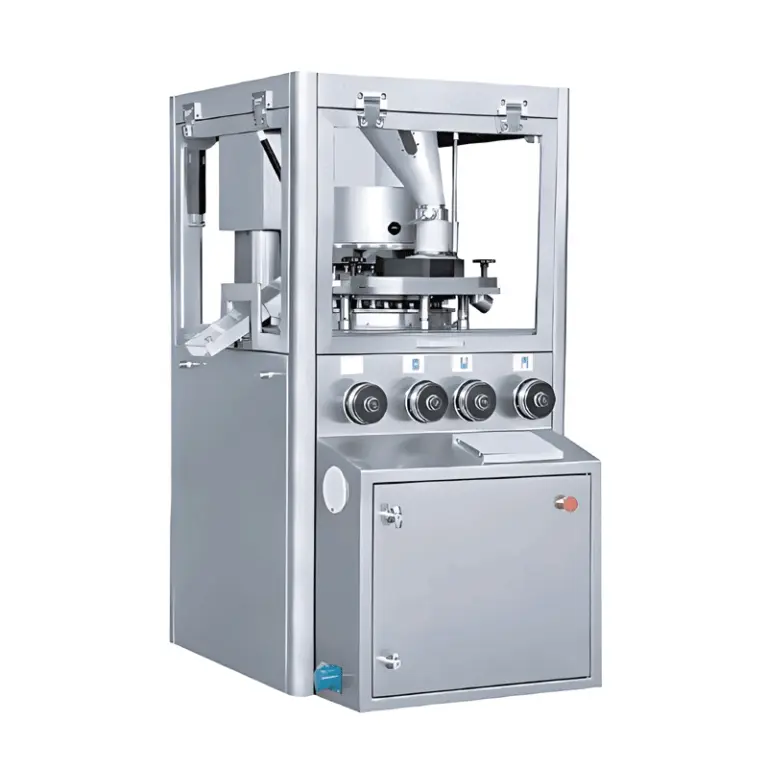
Tablets Machine Terminology And Its Practical Meaning
The phrase tablets machine is broad and can be interpreted differently depending on the context. In commercial equipment searches, it may refer to a machine used to produce tablets, but it does not necessarily identify one specific mechanical principle.
A buyer searching for a tablets machine may actually be looking for:
- A tablet press or compression machine
- A complete tablet production system
- Supporting equipment used before or after compression
- A machine for a particular tablet type
- A general pharmaceutical tablet manufacturing solution
This is why procurement teams should define the intended operation before contacting equipment suppliers.
For example, if the requirement is to compress a prepared powder blend into standard tablets, the key equipment is a tablet press. If the project includes powder preparation, granulation, drying, compression, dedusting, metal detection, coating, and packaging, then the requirement is much broader than one tablets machine.
FDA’s manufacturing equipment guidance states that there is no universal FDA-approved list of equipment. Manufacturers have flexibility to select equipment that meets their particular needs and applicable CGMP requirements.
Tablets Machine Vs Tablets Making Machine In Equipment Scope
The term tablets making machine is commonly used as a broader commercial description. It may refer to equipment designed to make tablets, while tablets machine may be used as a shorter search term for the same general requirement. In some cases, the term may refer to a single punch tablet press machine for small-scale or development applications.
The important point is that neither phrase alone necessarily defines the exact machine structure.
A supplier may use tablets making machine to describe a tablet press, while another supplier may use the same phrase to describe a broader tablet production solution. Therefore, buyers should focus on technical specifications rather than relying entirely on terminology.
A useful comparison is:
| Search term | Typical scope | What buyers should confirm |
|---|---|---|
| Tablets machine | Broad tablet equipment term | Exact operating principle |
| Tablets making machine | General tablet production term | Whether it means a press or complete system |
| Tablets manufacturing machine | Broader manufacturing equipment term | Included processing stages |
| Tablet press | Specific compression equipment | Compression method and tooling |
The term tablet press is more technically specific when the intended operation is powder compression. FDA’s manufacturing equipment classification specifically identifies tablet presses and distinguishes subclasses according to how powder is delivered to the die cavity.
Tablets Machine And The Role Of Tablet Compression
Compression is the stage that most clearly distinguishes a tablet press from other pharmaceutical processing equipment. In larger-scale production, a rotary tablet press machine can perform repeated compression cycles efficiently and consistently.
During compression, a prepared powder or granulated blend is fed into a die cavity and compressed using tooling. The material is transformed into a defined tablet shape and size through controlled mechanical force.
A tablets machine used specifically for this purpose is therefore better understood as compression equipment rather than a generic powder-processing machine.
The basic process can be described as:
- Prepared powder or granules enter the feeding system.
- Material fills the die cavity.
- Excess material is controlled to establish the target fill.
- Upper and lower punches compress the material.
- The formed tablet is ejected.
- The tablet moves toward downstream handling equipment.
FDA describes tabletting as the division of a powder blend into a single unit dose through application of compression force. Its equipment guidance also notes that tablet presses can use different powder-delivery principles and configurations.
This makes compression the central technical boundary when a buyer wants to identify a professional tablet press.
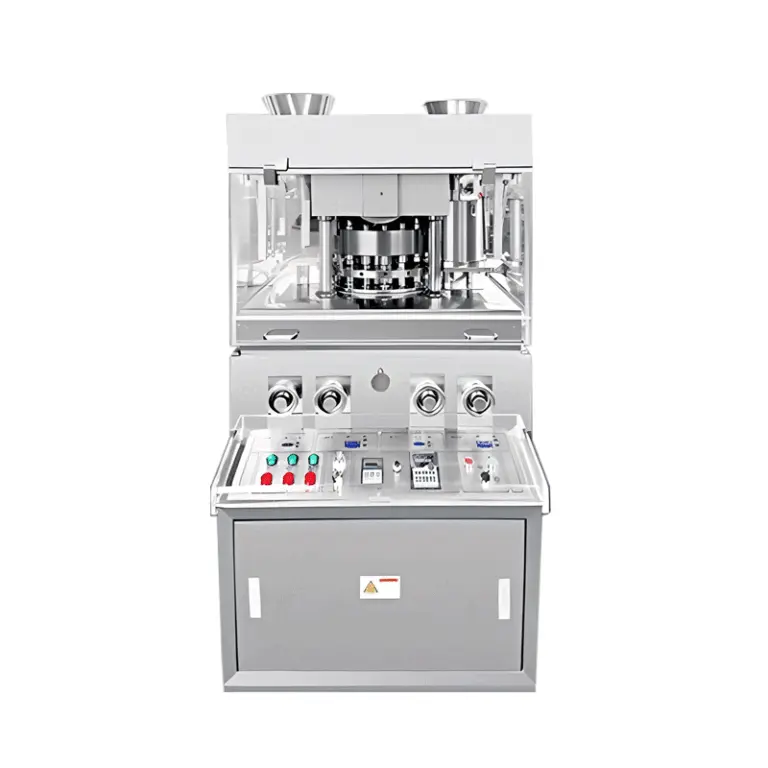
Tablets Machine Types Used In Pharmaceutical Production
Not every tablets machine has the same production structure. Different applications may require different press configurations, tooling arrangements, feeding systems, and control functions.
For pharmaceutical production, equipment may be selected according to tablet size, shape, output requirements, formulation characteristics, and process design.
Common categories include rotary tablet presses for higher-volume production and smaller or simpler compression systems for development or limited production applications.
A rotary configuration can support multiple compression stations around a rotating turret. This structure allows repeated filling, compression, and ejection cycles as the turret rotates.
The appropriate configuration depends on the product and process rather than simply the desired maximum speed.
FDA notes that different tablet compression equipment can influence tablet weight, hardness, and dose uniformity, while machine speed can affect die filling and tablet weight.
Therefore, selecting a tablets machine should involve formulation and process considerations in addition to nominal production capacity.
Tablets Machine And Supporting Equipment Around The Press
One common procurement mistake is treating the tablet press as though it performs the entire tablet manufacturing process. Other equipment, such as a capping machine, may also be required for downstream packaging and handling operations.
In practice, tablet production can involve several stages before and after compression. Depending on the formulation and manufacturing route, powder preparation may include dispensing, blending, granulation, drying, milling, and lubrication.
After compression, tablets may require dedusting, inspection, metal detection, coating, and packaging.
This means a tablets machine is normally one part of a larger process.
A typical production sequence may look like:
Material preparation → blending or granulation → drying and sizing → tablet compression → dedusting → inspection → coating or packaging
FDA inspection guidance specifically discusses equipment used for tablet production and notes that tablet manufacturing areas may include rotary tableting machines, coating and polishing equipment, punches, and dies. It also emphasizes maintenance and cleaning of equipment used in tableting operations.
Understanding this relationship helps purchasing teams avoid ordering a compression machine when they actually need a complete production solution.
Tablets Machine Selection Should Follow Product Requirements
A suitable tablets machine cannot be selected from output figures alone. The formulation has a direct influence on compression behavior.
Powder flow, particle size, moisture, density, lubrication, and compressibility can all affect die filling and tablet formation. Machine parameters also influence production results.
Important considerations include:
- Tablet diameter and shape
- Target tablet weight
- Required hardness and thickness
- Formulation flowability
- Compressibility
- Production speed
- Number of compression stations
- Tooling requirements
- Cleaning and changeover frequency
FDA inspection guidance identifies tablet weight, thickness, hardness, disintegration, and friability among the in-process tests relevant to tablet production.
For this reason, the right tablets machine should be selected as part of a controlled manufacturing process rather than as an isolated mechanical purchase.
Tablets Machine And Tablets Manufacturing Machine Differences
The phrase tablets manufacturing machine generally suggests a wider production scope than a machine used only for compression.
A tablets manufacturing machine may be used commercially to describe a broader system or equipment solution involved in tablet production. However, this does not establish a universal technical definition.
Buyers should ask a simple question: What operation does the quoted equipment actually perform?
If the answer is powder compression, the machine should be evaluated as compression equipment. If the quotation includes multiple processing stages, each stage should be identified separately.
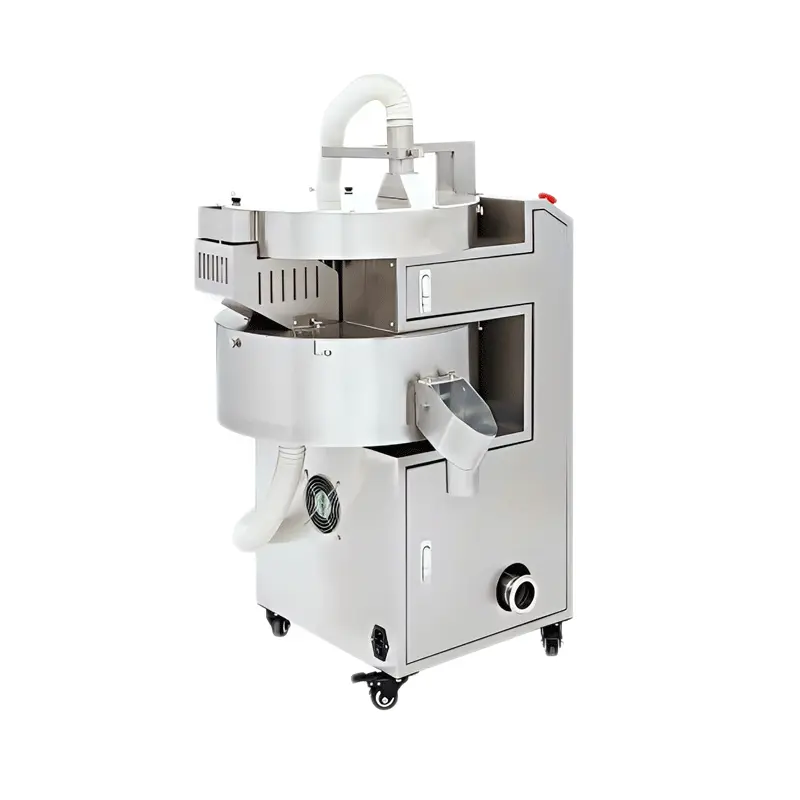
This distinction matters because equipment costs, utilities, installation requirements, cleaning procedures, validation activities, and operator responsibilities can vary significantly between a standalone press and a larger integrated system. Equipment such as a capsule polisher may also require separate cleaning, maintenance, and operating procedures when included in a broader production line.
WHO GMP principles emphasize that pharmaceutical manufacturing processes should be clearly defined, controlled, documented, and supported by suitable equipment and facilities.
Tablets Machine Procurement Questions For Pharmaceutical Buyers
Before requesting a quotation, purchasing teams should convert the general search term into specific technical requirements.
A useful procurement framework is:
- Define the tablet specifications.
- Confirm the formulation and material characteristics.
- Determine the required practical production capacity.
- Identify the compression principle and tooling requirements.
- List upstream and downstream equipment.
- Define cleaning and changeover expectations.
- Confirm control and monitoring requirements.
- Review maintenance and spare-parts requirements.
- Establish qualification and documentation expectations.
- Compare equipment according to the complete process requirement.
This approach is more reliable than comparing machines based only on the phrase tablets machine or tablets making machine.
The manufacturer should also provide information about equipment design, intended use, installation, cleaning, and maintenance. FDA CGMP requirements state that equipment should be appropriately designed for its intended use and facilitate cleaning and maintenance.
Tablets Machine Capacity And Actual Production Output
Production capacity is another area where terminology can create unrealistic expectations.
The theoretical output of a tablets machine may depend on the number of compression stations, turret speed, and the number of tablets produced during each compression cycle. However, actual output can be lower because of formulation characteristics, operating conditions, machine adjustments, tooling limitations, cleaning, and quality-control requirements.
For example, increasing machine speed does not automatically produce a proportional increase in usable output. Higher speed can influence powder filling and tablet weight, particularly when the formulation does not flow consistently.
FDA specifically notes that machine speed can affect die filling and tablet weight, which is why operating directions and process controls are important.
When comparing tablets manufacturing machine quotations, buyers should therefore distinguish between theoretical capacity and sustainable production output.
Tablets Machine Cleaning And GMP Requirements
Cleaning requirements are another important difference between a generic equipment search and an actual pharmaceutical procurement decision.
Product-contact surfaces should be compatible with the manufacturing process and designed to facilitate appropriate cleaning and maintenance. Equipment configuration should also reduce unnecessary powder accumulation and make critical areas accessible.
FDA states that equipment must be appropriately designed for its intended use and for cleaning and maintenance. The agency also emphasizes that equipment surfaces contacting components, in-process materials, or drug products should not adversely affect product quality.
WHO similarly describes GMP as a system covering production, quality control, premises, equipment, personnel, and documented procedures.
Therefore, a tablets machine intended for pharmaceutical production should be evaluated for more than mechanical performance. Cleanability, maintenance access, material compatibility, documentation, and process control are also relevant.
Tablets Machine Search Terms And Final Buying Decision
For buyers, the simplest way to distinguish these terms is to separate marketing language from technical function.
“Tablets machine” is a broad search phrase. “Tablets making machine” is also a general commercial description. “Tablets manufacturing machine” can imply an even broader production scope. None of these phrases, by themselves, guarantees a particular equipment structure.
When the actual requirement is compression, the buyer should confirm that the proposed equipment is a tablet press and then evaluate its compression method, feeding system, tooling, output, control system, cleaning design, and maintenance requirements.
The final selection should be based on the complete manufacturing process.
A practical comparison can be summarized as follows:
| Buyer requirement | Equipment focus |
|---|---|
| Form tablet from prepared powder | Tablet press |
| Develop compression process | Small-scale compression equipment |
| Produce tablets at commercial scale | Production tablet press |
| Handle several tablet-processing stages | Multiple machines or integrated production system |
| Search broadly for tablet equipment | Tablets machine / tablets making machine |
| Plan a complete tablet manufacturing process | Tablets manufacturing machine or integrated line |
The terminology is useful for finding equipment online, but technical specifications should determine the final procurement decision.
FAQ
Is a tablets machine the same as a tablet press?
Not necessarily. “Tablets machine” is a broad search term, while a tablet press specifically refers to equipment used to compress powder or granules into tablets.
What does tablets making machine usually mean?
It is generally a commercial description for equipment used to make tablets. Buyers should confirm whether the supplier means a tablet press or a broader production system.
What should I search for when I need compression equipment?
If the main requirement is compressing prepared powder into tablets, searching for tablet press or tablet compression equipment is more technically specific than using only a broad tablets machine term.