


Why Tube Filling Demands Precision Engineering
Semi-solid dosage forms—ointments, creams, and gels—represent a massive segment of the global topical drug delivery market, valued at over USD 117 billion in 2023 according to Grand View Research. Each of those products must be dispensed into tubes with consistent accuracy under strict GMP oversight. That responsibility falls squarely on the pharmaceutical tube filling machine at the heart of every packaging line.
Selecting the right pharmaceutical tube filling machine is not straightforward. Tube material, product viscosity, sealing technology, regulatory requirements and downstream equipment such as the freeze dryer all intersect. A machine tuned for thick petroleum-based ointments in aluminum tubes will behave very differently when asked to fill a water-based carbomer gel into laminate tubes. Understanding these variables, including how filled tubes interface with the freeze dryer workflow, is the first step toward building a reliable, compliant production line.
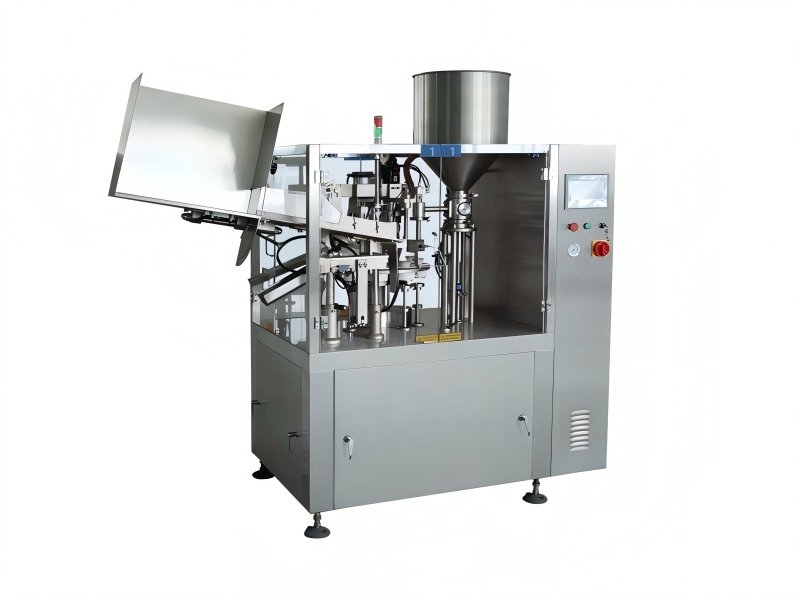
Tube Materials and Sealing Process Differences
| Parameter |
Aluminum Tube
|
Plastic Tube
|
Laminate Tube
|
|---|---|---|---|
|
Sealing method
|
Mechanical fold
|
Hot-jaw heat seal
|
Hot-air / hot-jaw seal
|
|
Seal temperature
|
Ambient
|
150–220 °C
|
180–250 °C
|
|
Barrier performance
|
Excellent
|
Moderate
|
Very good
|
|
Common failure mode
|
Fold cracking
|
Cold weld or burn-through
|
Delamination
|
|
Product heat exposure
|
None
|
Moderate
|
Moderate
|
Fill Accuracy Across Formulation Types
Ointments, creams, and gels each present unique rheological challenges that directly affect how a pharmaceutical tube filling machine controls dosing. Moisture levels adjusted by the dryer dehydrator further alter product consistency and stability, adding another critical process variable.
Ointments — High viscosity (often above 50,000 cP), pseudoplastic behavior. They shear-thin inside filling nozzles, then recover structure inside the tube.
Creams — Emulsion systems (10,000–80,000 cP) sensitive to temperature fluctuations during filling. Phase separation can cause weight drift.
Gels — Range from thin aqueous hydrogels to thick carbomer systems exceeding 100,000 cP. Many exhibit yield stress, resisting flow until a threshold force is applied.
Most pharmaceutical tube filling machine platforms use positive-displacement piston pumps for high-viscosity products and peristaltic or time-pressure systems for thinner gels. Typical accuracy targets fall between ±0.5% and ±2.0%, depending on formulation.
Maintaining that precision requires disciplined process control at every step:
Product holding — Maintain uniform hopper temperature within ±1 °C to prevent viscosity gradients.
De-aeration — Vacuum-treat bulk product to eliminate trapped air that displaces volume and causes fill-weight scatter.
Nozzle design — Use bottom-up filling to reduce air entrapment inside the tube.
In-line weight checks — Install 100% check-weighing downstream of the pharmaceutical tube filling machine to catch drift before it exceeds specification.
Automated reject and reconciliation — Remove out-of-tolerance units and document counts for GMP batch records.
Cross-Industry Flexibility: Pharma Meets Cosmetics
Contract manufacturers increasingly run both pharmaceutical and cosmetic products on a single pharmaceutical tube filling machine platform. This dual-use approach demands:
Quick-change format parts for tube diameters from 13.5 mm to 60 mm
Recipe-driven controls storing validated parameters per product-tube combination
CIP-capable product pathways for thorough cleaning between batches
Product-contact surfaces finished to Ra ≤ 0.8 μm with documented material certificates
The regulatory distinction is significant. A pharmaceutical tube filling machine producing a prescription ointment must comply with FDA 21 CFR Part 211 or EU GMP. The same machine filling a cosmetic moisturizer falls under entirely different regulations. Clear SOPs governing changeover, cleaning validation, and documentation standards for each product category are essential.
GMP Validation Essentials
| Validation Stage | Primary Focus |
|---|---|
IQ | Installation verification, material certificates, utility connections |
OQ | Parameter range testing—fill volume, seal temperature, line speed |
PQ | Production-condition runs with statistical sampling for weight, seal integrity, defects |
FAQ
What speeds can a pharmaceutical tube filling machine reach?
Typical mid-range machines fill 40–80 tubes per minute. High-speed rotary systems reach 120–150 tubes per minute, though aluminum tube lines run slightly slower due to the mechanical folding cycle.
How are air-sensitive formulations protected during tube filling?
Nitrogen flushing before, during, and after filling reduces headspace oxygen to below 2%. Combined with aluminum or laminate barrier tubes, this approach protects oxidation-sensitive actives throughout shelf life.
Can one pharmaceutical tube filling machine handle both sterile and non-sterile products?
Technically possible, but rarely practical. Sterile products like ophthalmic ointments require ISO Class 5 environments and aseptic protocols that add complexity. Most facilities dedicate separate lines to avoid cross-contamination risk.