


Tablets are the world’s most widely used solid dosage form—affordable to produce, easy to transport, and convenient for patients. Behind every tablet lies a precise compression process powered by a pharmaceutical tablet press machine. This equipment transforms loose powder or granules into uniform, durable tablets at speeds ranging from a few hundred to over a million tablets per hour.
Choosing the right press requires understanding how the machine works, what types are available, and how to align your selection with Good Manufacturing Practice (GMP) requirements. This guide walks through the four-stage compression cycle, compares the three main machine types—single-punch, rotary, and high-speed rotary—and offers practical advice on workshop layout and tooling selection.

What a Tablet Press Machine Does
The Four-Stage Compression Cycle
Regardless of type, every pharmaceutical tablet machine follows the same fundamental cycle. Understanding these four stages clarifies how the equipment produces uniform tablets.
Filling
Metering
Metering, sometimes grouped with filling, adjusts the fill to the exact required amount. The lower punch rises slightly to displace excess material, which a scraper removes and returns to the feed system. This ensures each die holds a precise dose before compression. Accurate metering directly influences the weight consistency of every tablet produced and is regularly verified with calibrated weight scale for ongoing quality assurance.
Compression
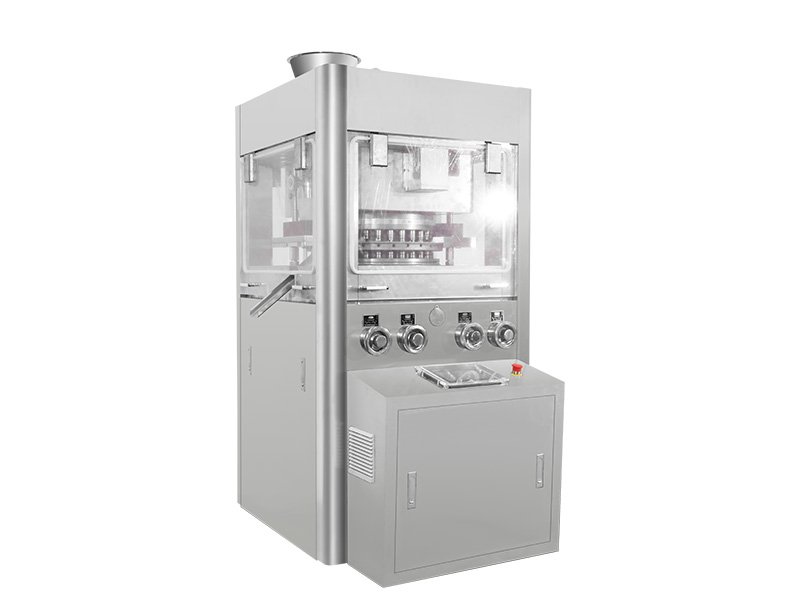
Compression is the defining stage of the pharmaceutical tablet press machine. The upper and lower punches converge, and the powder passes between compression rollers that apply controlled force. This pressure binds the particles into a solid, coherent tablet produced by the pharmaceutical tablet press machine. The applied force governs tablet hardness, thickness, and dissolution behavior. Many modern pharmaceutical tablet press machines monitor compression force in real time, rejecting tablets that fall outside tolerance.
Ejection
In the final stage, the lower punch rises to push the finished tablet out of the die. A take-off blade then guides the tablet away from the machine into a collection container. The die is now empty and ready for the next filling cycle. Smooth ejection prevents defects such as capping or sticking, and well-maintained tooling is essential here.
The table below summarizes what happens at each stage:
| Stage | Action | Key Outcome |
|---|---|---|
Filling | Die fills with material | Determines tablet weight |
Metering | Excess removed to exact dose | Ensures weight consistency |
Compression | Punches apply controlled force | Sets hardness and thickness |
Ejection | Tablet pushed out of die | Delivers finished tablet |
The Three Main Types of Tablet Press
Single-Punch (Eccentric) Press
The single-punch pharmaceutical tablet press machine is the simplest design, using one set of punches and one die. It operates in an eccentric motion: material fills the die, the upper punch descends to compress, and the tablet ejects—repeating this stamping cycle for the pharmaceutical tablet press machine.
Single-punch machines are compact, affordable, and ideal for research, development, and very small batches. Their output is modest, typically producing several thousand tablets per hour. Because only the upper punch moves during compression, the force is applied from one side, which can affect uniformity in thick tablets.
Best for: R&D, formulation trials, pilot production, and small runs.
Rotary Press
The rotary press dramatically increases output by mounting multiple sets of punches and dies on a rotating turret. As the turret turns, each station passes through the four stages in sequence, so many tablets are produced simultaneously. Compression occurs from both the upper and lower punches, improving uniformity.
Rotary presses are the workhorses of commercial production, offering a strong balance of output, flexibility, and quality. Output depends on turret size and speed but commonly reaches tens of thousands to hundreds of thousands of tablets per hour.
Best for: Mid-to-large commercial manufacturing.
High-Speed Rotary Press
High-speed rotary pharmaceutical tablet press machines are advanced versions of the standard rotary press, engineered for maximum throughput. They feature larger turrets, more punch stations, sophisticated feed systems, and comprehensive automation built into these pharmaceutical tablet press machines. Many of these pharmaceutical tablet press machine models include dual compression zones, in-line force monitoring, and automatic rejection of defective tablets.
These machines can produce well over a million tablets per hour and are built for large-scale, continuous production where efficiency is paramount.
Best for: High-volume commercial manufacturing.
Comparing the Three Types
| Type | Output | Automation | Investment | Typical Use |
|---|---|---|---|---|
| Single-punch | Low | Minimal | Lowest | R&D, small batches |
| Rotary | High | Moderate | Higher | Commercial production |
| High-speed rotary | Very high | Extensive | Highest | Large-scale output |
How to Select the Right Tablet Press
Choosing the correct pharmaceutical tablet press machine involves weighing several factors together. Follow this ordered approach to structure your decision:
Define your output needs — Estimate current and projected volume over the equipment’s lifespan.
Understand your formulation — Powder flowability, granule characteristics, and tablet size affect press choice.
Determine tablet specifications — Shape, diameter, hardness, and any special features such as scoring or embossing.
Assess automation requirements — Higher volumes justify greater automation and in-line controls.
Confirm GMP compliance — Verify materials, cleanability, and validation support.
Evaluate total cost of ownership — Include tooling, maintenance, spare parts, and labor.
A small manufacturer developing new formulations naturally starts with a single-punch machine, while an established producer running steady volumes fits a rotary press. Large-scale operations demand high-speed rotary equipment. Matching capacity to genuine need prevents both bottlenecks and wasted capital.
Tooling Selection: Punches and Dies
Tooling is the heart of any pharmaceutical tablet machine, directly shaping tablet quality. Punches and dies must be selected carefully and maintained diligently.
Key considerations when selecting tooling include:
Tablet dimensions and shape — Round, oval, capsule-shaped, or custom profiles require matching tooling.
Tooling standard — Common standards such as TSM and EU (Euro) define dimensions; consistency across your operation simplifies inventory.
Steel grade — Harder steels resist wear and suit abrasive formulations; premium coatings reduce sticking.
Embossing and scoring — Logos, product codes, and break lines require precision-engineered punch tips.
Surface finish — A smooth, polished finish minimizes sticking and eases cleaning.
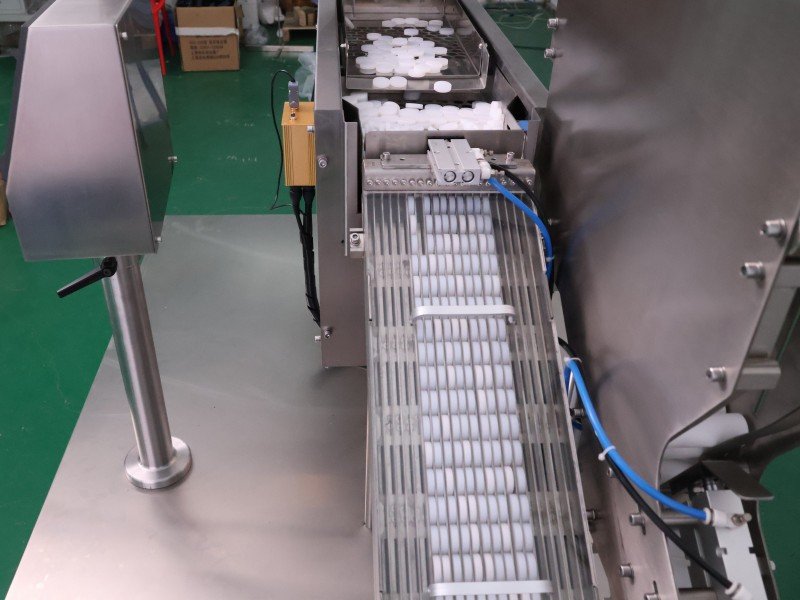
Well-chosen, properly maintained tooling for pharmaceutical industry production machine reduces defects such as capping, lamination, sticking, and picking. It also extends service life and lowers long-term cost. Regular inspection, cleaning, and correct storage of punches and dies are essential practices in any tablet manufacturing operation relying on pharmaceutical industry machine.
GMP Workshop Layout Considerations
Compliant tablet production depends not only on the machine but on the environment around it. GMP guidelines from authorities such as the FDA and EMA emphasize preventing contamination, mix-ups, and cross-contamination through thoughtful facility design.
Cleanroom Classification and Airflow
Tablet compression areas require appropriate air cleanliness classification, controlled temperature and humidity, and adequate air changes. Powders generate dust, so effective dust extraction and containment protect both product integrity and operator health. Differential air pressure between rooms helps prevent cross-contamination.
Material and Personnel Flow
A well-designed workshop for pharmaceutical industry machines separates the flow of materials, personnel, and waste to avoid crossover. Consider these principles when planning layout for pharmaceutical industry machines:
Establish clear, one-directional flows for raw materials, in-process goods, and finished tablets.
Provide dedicated gowning and airlock areas for personnel entry.
Position the tablet press to allow easy access for operation, cleaning, and maintenance.
Locate dust collection systems close to the compression point.
Allow sufficient space around equipment for safe operation and thorough cleaning.
Cleaning and Cross-Contamination Control
Surfaces in the compression room should be smooth, non-shedding, and easy to clean. The press itself should feature GMP-compliant construction with pharmaceutical-grade stainless steel contact parts and minimal dead zones. Effective cleaning procedures and validation prevent residue from one batch contaminating the next—a particular concern when the same equipment handles multiple products.
The following table outlines core GMP layout elements and their purpose:
| Element | Purpose |
|---|---|
Air classification and filtration | Control airborne contamination |
Dust extraction | Protect product and operators |
Differential pressure | Prevent cross-contamination |
Segregated flows | Avoid material and personnel mix-ups |
Cleanable surfaces | Enable effective sanitation |
Equipment access space | Support cleaning and maintenance |
Validation and Documentation
No pharmaceutical tablet press machine enters production without validation. Installation Qualification (IQ), Operational Qualification (OQ), and Performance Qualification (PQ) demonstrate that the equipment is installed correctly, operates as intended, and consistently produces tablets meeting specification. Complete documentation supports regulatory approval and provides a reference for ongoing operation. When evaluating suppliers, confirm they provide thorough validation packages and reliable technical support.
FAQ
What is the difference between a single-punch and a rotary tablet press?
A single-punch press uses one set of tooling and compresses tablets one at a time in an eccentric stamping motion, making it ideal for R&D and small batches. A rotary press mounts multiple tooling sets on a rotating turret, producing many tablets simultaneously with double-sided compression. Rotary presses deliver far higher output and better uniformity, suiting commercial production.
How do I prevent common tablet defects like capping and sticking?
Capping and sticking often stem from formulation issues, worn tooling, or incorrect compression settings. Prevention includes proper granulation, adequate lubrication, well-maintained and polished tooling, appropriate compression force, and controlled ejection. Regular tooling inspection and correct machine setup significantly reduce these defects.
What GMP requirements apply to a tablet compression workshop?
A compliant workshop requires appropriate air cleanliness classification, controlled temperature and humidity, effective dust extraction, and differential air pressure to prevent cross-contamination. Material, personnel, and waste flows must be segregated, surfaces must be cleanable, and equipment must use pharmaceutical-grade materials. Validation (IQ, OQ, PQ) and thorough documentation are also mandatory.