


Granulation remains one of the most critical unit operations in pharmaceutical solid dosage form manufacturing. It transforms fine powders into larger, more uniform granules, improving flowability, compressibility, and content uniformity while reducing segregation and dust generation. The selection of an appropriate granulation machine for pharmaceutical application depends on multiple factors—API properties, formulation requirements, production scale, and regulatory considerations.
This article examines the fundamental divide between wet and dry granulation technologies, with particular focus on fluid bed granulation and roller compaction. We analyze how each approach affects material stability and provide a practical decision matrix to guide equipment selection.
The Fundamental Divide: Wet vs Dry Granulation
The most significant difference between wet and dry granulation lies in the use of liquid binders. Wet granulation requires the addition of a liquid solution to promote particle adhesion, while dry granulation uses mechanical forces—compression—to achieve the same effect without any liquid. Both processes often rely on an industrial pulverizer machine to reduce oversized agglomerates into uniform particle sizes after granulation is completed.
Wet Granulation — The Liquid-Based Approach
Wet granulation involves adding a liquid binder (water or organic solvents such as ethanol or isopropanol) to powder particles to promote adhesion, allowing them to form more uniform granules. The process typically encompasses four key mechanisms that occur simultaneously and continuously: wetting (nucleation), growth, consolidation, and breakage.
Wet granulation is the most commonly used method for producing granules in the pharmaceutical industry. It is particularly suitable for:
Low-dose active ingredients requiring uniform distribution
Formulations with poor compressibility
Products requiring precise control over drug release profiles
Dry Granulation — The Mechanical Compression Route
Dry granulation is a moisture-free process that compresses powdered particles into granules, offering advantages such as preventing moisture-induced degradation in APIs and formulations. In this process, powders are compacted into ribbons, which are then subjected to milling and sieving to produce granules of suitable particle size for subsequent tableting or capsule filling.
Dry granulation is particularly advantageous for:
Moisture-sensitive APIs
Heat-sensitive compounds
High-drug-loading formulations
Continuous manufacturing operations
Fluid Bed Granulation — The All-in-One Wet Granulation Solution
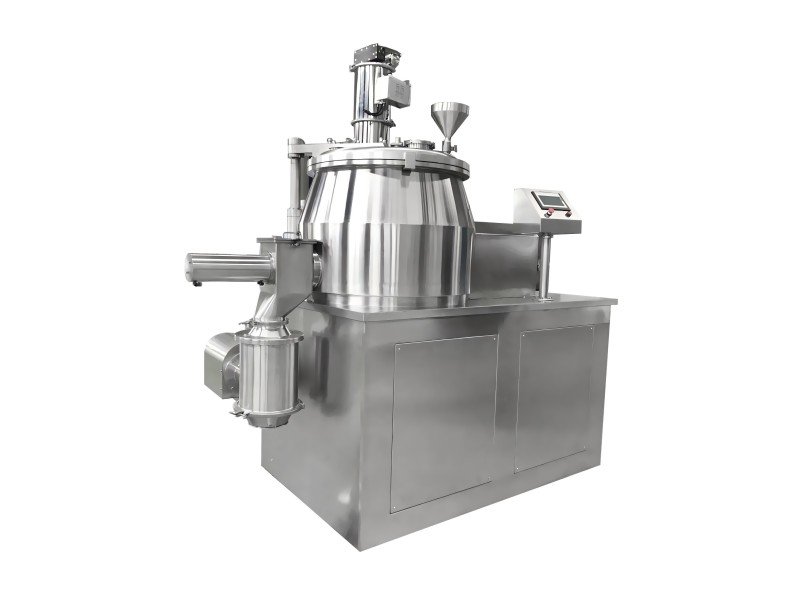
Fluid bed wet granulation (FBG) is a common pharmaceutical production machine that operates as a key unit operation where a powder blend is fluidized, sprayed with a binder solution, and dried within a single process vessel. The purpose of including this granulation step in a drug product manufacturing process is to improve physical properties of an API by agglomerating polydisperse particles into a uniform size distribution.
How Fluid Bed Granulation Works
Critical Process Parameters in Fluid Bed Granulation
The quality of granules produced by fluid bed granulation is governed by several interrelated parameters:
Airflow rate — Determines fluidization quality and particle movement
Inlet air temperature — Controls drying kinetics and granule moisture content
Binder spray rate — Influences granule growth rate and size distribution
Bed porosity — Affects heat and mass transfer efficiency
Maximum loss on drying (LOD) — Critical for endpoint determination
Stable fluidization is critical for control of fluidized bed granulation processes, and process control includes mass, energy, and fluidization balances. Balanced control of fluidization can be challenging, particularly with micronized powders prone to elutriation.
Material Stability Considerations in Fluid Bed Granulation
Fluid bed granulation offers distinct advantages for material stability:
Uniform thermal exposure — The fluidized state ensures even heat distribution throughout the bed, minimizing localized overheating
Controlled moisture addition — Precise spray rate control prevents over-wetting and reduces the risk of API hydrolysis
Single-vessel processing — Eliminates transfer-related degradation risks
Tablets produced by fluidized-bed granulation demonstrate the best properties in terms of tensile strength and mass variation compared to other granulation techniques. The fluid bed process also produces granules with relatively low bulk density and high porosity, which can enhance dissolution characteristics.
However, fluid bed granulation does involve heat and moisture exposure, which may not be suitable for all APIs. The process is typically operated as a batch process, though semi-continuous manufacturing systems have recently emerged.
Roller Compaction — The Dry Granulation Workhorse
Roller compaction stands as the leading dry granulation technology for solid oral dosage forms, delivering enhanced powder properties without the use of water or solvents. This technique is valued for its scalability and suitability for moisture- and heat-sensitive materials that would otherwise require processing via a freeze dryer to avoid thermal degradation.
How Roller Compaction Works
Roller compaction is a powder processing operation used in dry granulation manufacturing to create denser, free-flowing granules without heat or a liquid binder. The process consists of three main steps:
Powder feeding — Material is fed via a screw system to counter-rotating rollers
Densification and ribbon formation — Pressure from the rollers compacts the powder, forming thin ribbons
Milling and granulation — Ribbons are milled into granules used as drug product intermediates
The roller compactor is designed with three integrated functions: compression, crushing, and granulation. This turnkey design enables continuous processing from powder feed to granule output.
Critical Process Parameters in Roller Compaction
The interplay of process parameters directly shapes ribbon solid fraction, tensile strength, and critical granule properties. Key parameters include:
Roll pressure/compaction force — Determines ribbon density and granule strength
Roll gap — Controls ribbon thickness and throughput
Roll speed — Affects residence time and densification
Feed screw dynamics — Influences material delivery consistency
Milling conditions — Determines final particle size distribution
Granule particle size is mostly dependent on variation in roll pressure, roll speed, and mill speed. During scale-up, the complex coupling effects among these parameters can induce significant alterations in particle quality attributes, compromising product consistency.
Material Stability Considerations in Roller Compaction
Roller compaction offers irreplaceable advantages in processing heat-sensitive or moisture-sensitive materials:
No thermal degradation — The process generates minimal heat, protecting thermolabile APIs
No hydrolysis risk — Absence of liquid binders eliminates moisture-induced degradation
Continuous operation — Enables consistent processing with reduced batch-to-batch variability
Granules manufactured by roll compaction/dry granulation show no loss in tabletability even for more compacted and strong granules. The process produces denser granules compared to fluid bed granulation, which can be advantageous for high-dose formulations requiring smaller tablet sizes.
However, dry granulation requires drugs or excipients with cohesive properties to help the formation of granules and may not be suitable for all formulations. Granules produced by dry granulation may exhibit lower uniformity compared with those produced by wet granulation.
Impact on Material Stability
The choice between fluid bed granulation and roller compaction has profound implications for material stability. Each technology presents distinct challenges and opportunities.
Thermal Stability
Fluid bed granulation — Operates with heated air (typically 40–80°C). While temperature control is precise, prolonged exposure may affect thermolabile compounds
Roller compaction — Generates minimal heat; suitable for heat-sensitive APIs without degradation risk
Moisture Sensitivity
Fluid bed granulation — Requires liquid binder addition and subsequent drying. Moisture-sensitive APIs may require protective measures or alternative approaches
Roller compaction — Completely moisture-free; ideal for hydrolysis-prone compounds
Mechanical Stress
Fluid bed granulation — Gentle particle collision and growth; minimal mechanical stress on API crystals
Roller compaction — High-pressure compression may cause polymorphic转变 or crystal damage in sensitive materials
Granule Properties
| Property | Fluid Bed Granulation | Roller Compaction |
|---|---|---|
| Granule density | Low to medium | High |
| Porosity | High | Low |
| Tablet tensile strength | Best among techniques | Good, no loss in tabletability |
| Dissolution rate | Faster due to high porosity | Slower due to densification |
| Flowability | Good | Excellent |
| Uniformity | Very good | May exhibit lower uniformity |
| Fines generation | Low | Can be significant |
Key Process Control Strategies
For Fluid Bed Granulation
Effective control of fluid bed granulation requires attention to:
Enthalpy balance — Provides guidelines for process parameters including airflow, temperature, and spray rate
Aggregated Process Parameter (APP) — Combines key parameters including maximum LOD, spray rate, and bed porosity for efficient CQA characterization
Optimal batch size — Generally between 30% and 80% of the total volume of the granulator bowl
Evaporative energy to drying capacity (EE/DC) ratio — Enables scale-up while maintaining granule characteristics
For Roller Compaction
Effective control of roller compaction requires attention to:
Model-based approaches — Johanson model and numerical simulation help predict scale-up behavior
Feed screw calibration — Ensures consistent material delivery to the compaction zone
Roll force monitoring — Critical for maintaining ribbon density consistency
Milling optimization — Controls final particle size distribution
FAQ
Can fluid bed granulation be used for heat-sensitive APIs?
Yes, but with careful parameter control. Fluid bed granulation operates with heated air, typically at 40–80°C. For heat-sensitive APIs, optimizing inlet air temperature, reducing exposure time, and using appropriate binder systems can minimize thermal degradation risks. However, for highly thermolabile compounds, roller compaction may be the safer choice.
Which granulation method produces better tablet dissolution profiles?
Fluid bed granulation generally produces tablets with faster dissolution profiles due to the high porosity of the granules. The porous structure facilitates rapid wetting and drug release. Roller compaction produces denser granules, which may result in slower dissolution—though this can be advantageous for sustained-release formulations.
How do I determine whether my formulation is suitable for dry granulation?
A formulation is suitable for dry granulation if the API and excipients possess sufficient cohesive properties to form stable compacts under pressure. Key indicators include acceptable powder flow, adequate compressibility, and stability under mechanical stress. Pilot-scale roller compaction trials with ribbon density and granule strength evaluation are recommended to confirm feasibility before committing to production-scale equipment.