


In modern pharmaceutical manufacturing, the pharmaceutical coating machine stands as one of the most critical pieces of equipment for oral solid dosage form production. Whether applied to tablets or capsules, coating serves multiple essential functions: masking unpleasant tastes and odors, protecting active pharmaceutical ingredients (APIs) from environmental degradation, controlling drug release profiles, and enhancing product appearance for improved patient compliance. This comprehensive guide explores the working principle of the pharmaceutical coating machine, with particular focus on the high-efficiency pan coater, the three-stage atomization-spraying-drying control system, and formulation considerations for sugar, film, and enteric coatings.
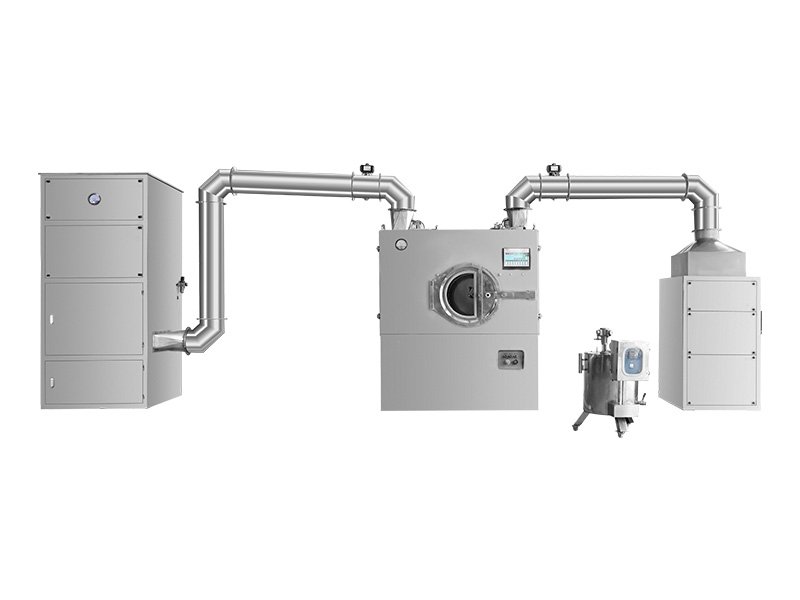
Overview of the Pharmaceutical Coating Machine
A pharmaceutical coating machine is an industrial system designed to apply a uniform layer of coating material onto solid dosage forms. The most widely used configuration in the industry is the pan coater, which features a rotating drum that tumbles tablets or capsules while a spray system applies the coating solution and a drying system removes solvents. Once coating and drying are fully completed, finished products are transferred to a packaging machine for subsequent sealing and final packaging.
Core Components of a Pan Coater
A standard pan coater comprises four primary systems:
The Drum (Coating Pan) : A rotating vessel that holds and tumbles the tablets. Drums range from research-scale units holding approximately 10 liters to industrial-scale drums exceeding 2,000 liters (about 2 tons of material). Modern high-efficiency designs feature fully perforated drums with high open-area ratios, enabling maximum airflow and efficient heat transfer that significantly shorten batch times.
The Spray System: The core of the pan coater, responsible for atomizing the coating suspension into fine droplets. Air-atomized spray nozzles are positioned above the tablet bed to ensure even distribution.
The Heating and Ventilation System: Controls process air temperature, humidity, and volume to regulate drying.
The Control System: Modern coaters use PLC-based automation to monitor and control critical parameters including inlet air temperature, drum speed, spray rate, and atomization air pressure.
Working Principle of the High-Efficiency Pan Coater
The working principle of a high-efficiency pharmaceutical coating machine revolves around three simultaneous and interdependent processes: tablet bed movement, coating application, and controlled drying.
Tablet Bed Movement and Mixing
The coating process begins when tablets are loaded into the rotating drum. As the motor drives the pan in circular motion, the tablets are continuously lifted and tumbled by specially designed baffles and guide plates. This “Z”-pattern flow path ensures that every tablet passes repeatedly through the spray zone, achieving uniform coating exposure. Multiple auxiliary machine units support stable running throughout the cycle, including air handling and solution delivery systems. The pan speed must be carefully optimized—too slow and tablets may stick together (twinning); too fast and coating defects such as chipping or picking may occur.

The Three-Stage Process—Atomization, Spraying, and Drying
Stage 1: Atomization
Atomization is the process of breaking the liquid coating solution into fine droplets. The atomizing air disperses the coating solution, with droplet size and distribution directly affecting coating quality. The correct atomizing air pressure produces smaller droplets, which decreases surface roughness and enables better coalescence and smoother films. Critical atomization parameters include:
Atomization air pressure (typically measured in bar or psi)
Pattern air pressure for spray shape control
Nozzle type and orifice diameter
Stage 2: Spraying
The atomized coating suspension is sprayed directly onto the tumbling tablet bed. Spray nozzles are positioned above the bed, and the spray pattern must cover the tablet cascade evenly. The spray rate—the quantity of suspension applied per unit time—must be carefully controlled. Key spraying parameters include:
Spray rate (grams per minute per gun)
Gun-to-bed distance and angle
Spray pattern geometry
Stage 3: Drying
Simultaneous with spraying, heated process air flows through the tablet bed under controlled negative pressure. This airflow evaporates solvents from the coating droplets, leaving a solid film on each tablet surface. The drying stage involves:
Inlet air temperature control
Air volume and velocity management
Humidity control of incoming process air
| Parameter | Typical Range | Impact on Coating Quality |
|---|---|---|
| Inlet Air Temperature | 40–65°C (aqueous coatings) | Affects drying rate and film formation; too low causes overwetting, too high causes spray drying |
| Spray Rate | 5–220 g/min per gun | Controls moisture input; excessive flow leads to picking/sticking, insufficient flow reduces production efficiency |
| Pan Speed | 3–24 RPM | Influences tablet mixing, dwell time in spray zone, and coating uniformity |
| Atomization Air Pressure | 0.6–5.0 kg/cm² | Determines droplet size; higher pressure = finer droplets, smoother films |
| Inlet Airflow | Equipment-dependent | Affects drying capacity and heat transfer efficiency |
The Importance of Process Balance
The coating process comprises simultaneous heat and mass exchange processes: heat exchange between inlet air, spray droplets, and tablets; and mass exchange between sprayed material, inlet air, tablets, and the coating pan. For certain low-solvent formulations or heat-sensitive products, a vacuum dryer may be deployed in linked workflows to supplement moisture removal. Achieving the right balance between wetting and drying is essential for a smooth, uniform result.
If the spray rate is too high relative to drying capacity, tablets become overwet, leading to:
Picking: Coating material pulled from tablet surfaces
Sticking: Tablets adhering to each other or to the pan
Twinning: Two or more tablets sticking together
Conversely, if drying is too aggressive or spray rate too low:
Spray drying: Droplets dry before reaching tablet surfaces
Reduced coating efficiency
Rough, porous film surfaces
Scale-Up Considerations
Scaling up coating processes from laboratory to production scale requires careful attention to several principles:
Batch size: Scale-up is largely dependent on pan size; bed depth proportional to pan depth should be maintained
Pan RPM: Based on keeping linear distance traveled by tablets per unit time constant
Airflow: Must be scaled in coordination with spray rate; equipment providing five-fold batch size increase may only allow two-fold air flow increase
Product temperature: Should remain constant across scales

Common Coating Defects and Troubleshooting
| Defect | Description | Primary Causes | Solutions |
|---|---|---|---|
| Picking | Coating material pulled from tablet surface | Spray rate too high; inadequate drying | Reduce spray rate; improve drying conditions |
| Twinning | Tablets sticking together | Sticky formulation; poor evaporation; pan speed too low | Adjust formulation; increase pan speed; improve drying |
| Orange Peel | Rough, uneven surface | Droplet size too large; poor atomization | Increase atomization air pressure |
| Logo Bridging | Coating fills in tablet logos | Spray rate too high; insufficient drying | Reduce spray rate; optimize drying parameters |
| Color Variation | Uneven color within batch | Inconsistent mixing; spray pattern issues | Optimize pan speed; check nozzle alignment |
Conclusion
The pharmaceutical coating machine—particularly the high-efficiency pan coater, a core pharmaceutical production machine—is an indispensable tool in modern pharmaceutical manufacturing. Its working principle revolves around the precise coordination of three simultaneous stages: atomization, spraying, and drying. Success depends on careful control of critical parameters including spray rate, inlet air temperature, pan speed, and atomization air pressure. The choice between sugar, film, and enteric coatings depends on the specific requirements of the drug product, with each type demanding distinct formulation approaches and process configurations. Film coating has become the dominant method due to its efficiency and versatility, while enteric coating provides essential functionality for acid-sensitive drugs. Understanding the working principle of the pharmaceutical coating machine and mastering the interplay of process parameters enables manufacturers to fully leverage this vital pharmaceutical production machine to achieve consistent, high-quality coated products that meet regulatory standards and patient expectations. Well-coated tablets and capsules can then proceed smoothly to downstream equipment including the capping machine for final assembly.
FAQ
What is the difference between a perforated and non-perforated coating pan?
Perforated coating pans feature a drum with numerous small holes that allow process air to flow directly through the tablet bed, providing superior drying efficiency and heat transfer. Non-perforated (solid) pans rely on airflow over the bed surface, resulting in slower drying and longer batch times. Perforated pans are the modern industry standard for film and enteric coating applications.
How does coating solution viscosity affect the coating process?
Coating solution viscosity directly impacts atomization efficiency and droplet size. Higher viscosity solutions require higher atomization air pressure to achieve the same droplet size distribution. Viscosity also affects the spreading and coalescence of droplets on tablet surfaces—if too high, droplets may not spread adequately, leading to rough or uneven films; if too low, the solution may run off tablets before drying.
What is the recommended approach for troubleshooting tablet sticking during coating?
Tablet sticking typically indicates an imbalance between wetting and drying. The recommended troubleshooting approach includes: (1) reduce the spray rate to decrease moisture input; (2) increase inlet air temperature or airflow to enhance drying capacity; (3) adjust pan speed to improve tablet mixing and reduce dwell time in the spray zone; (4) review the coating formulation for excessive tackiness and consider adding anti-tacking agents. Process parameters should be adjusted incrementally while monitoring exhaust air temperature as an indicator of drying efficiency.