


In pharmaceutical manufacturing, the selection of a pharmaceutical mixer machine is one of the most consequential decisions a production team can make. A failed blend uniformity test on the eve of batch release can trigger a formal GMP non-compliance investigation, expensive reprocessing of materials, and the potential loss of high-value APIs that can cost hundreds of dollars per gram. The global market for pharmaceutical processing machines stood at $25.2 billion in 2024 and is projected to reach $46.4 billion by 2034—a testament to the critical role these systems play in modern drug manufacturing.
Yet many manufacturers struggle to distinguish between the available options. V-blenders, double cone blenders, IBC bin blenders, and high shear homogenizers each serve distinct purposes, and choosing incorrectly can compromise product quality, operational efficiency, and regulatory compliance. This guide provides a comprehensive comparison of these four core technologies, with particular emphasis on their application matrices and cleaning efficiency—two factors that increasingly determine long-term operational success.
Understanding the Core Mixing Mechanisms
Before comparing specific equipment types, it is essential to understand the three fundamental mixing principles that govern how a pharmaceutical mixer machine achieves uniformity:
Convective Mixing involves the macro-movement of large groups of particles from one location to another within the mixer, achieved by paddles, blades, or the rotation of the entire vessel. This mechanism enables rapid bulk blending.
Diffusive Mixing (also known as shear mixing) occurs at a smaller scale, involving the movement of individual particles over one another. This is crucial for achieving a high degree of uniformity, especially in powder blends.
High-Shear Mixing applies intense mechanical energy to break down particles, droplets, or agglomerates. A rotor moving at high speed within a stationary stator creates hydraulic shear, essential for creating stable emulsions, suspensions, and fine dispersions.
The selection of a mixing machine ultimately comes down to matching the right mixing mechanism to your specific materials and process objectives.
Tumble Blenders for Dry Powder Blending
Tumble blenders—including V-blenders, double cone blenders, and IBC bin blenders—represent the most widely used category of pharmaceutical mixer machine for solid-solid blending applications. These diffusion blenders achieve powder homogeneity through the gentle, three-dimensional movement of the blender vessel itself rather than through rotating impellers or mechanical agitators. Many formulations pass through a dryer dehydrator prior to blending to stabilise moisture content, directly impacting mixing consistency. The absence of mechanical agitators means there is no imposed shear on the product, making diffusion blending the method of choice wherever product integrity and content uniformity are primary requirements.
V-Blender
The V-blender is the most widely used diffusion blender geometry in pharmaceutical dry powder blending, particularly for the final blend step in oral solid dosage (OSD) manufacturing prior to tablet compression or capsule filling, while separate mixing workflows support formulations processed on an oral liquid filling machine for liquid pharmaceutical products.
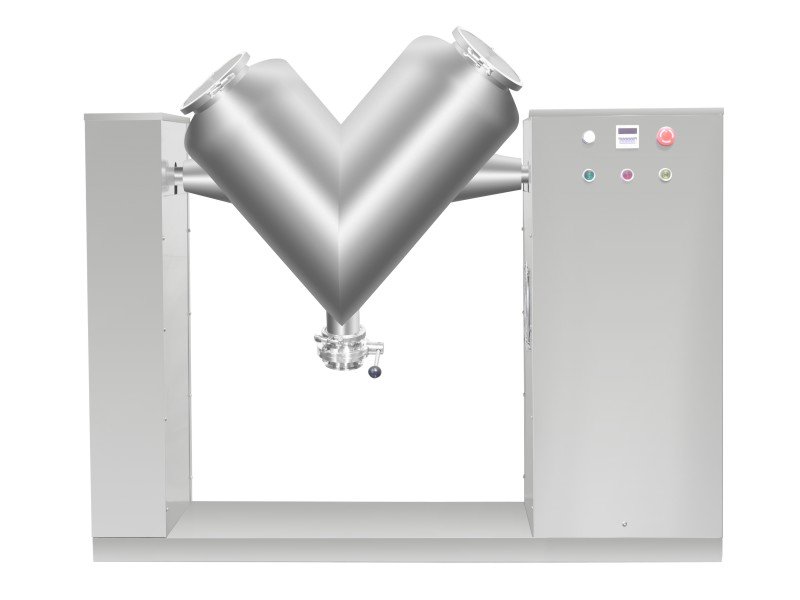
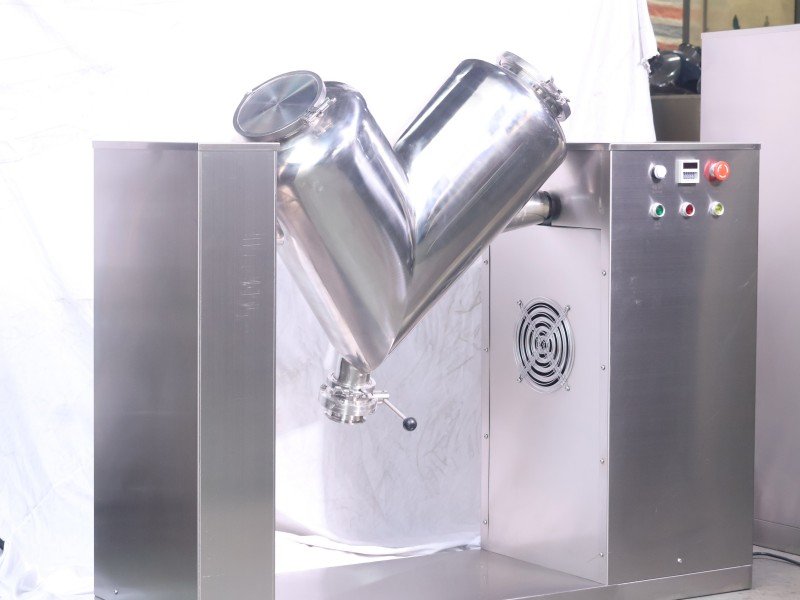
How it works: The V-blender consists of two cylindrical shells joined at an angle, forming a distinctive V-shaped vessel. As the vessel rotates on its horizontal axis, the powder mass is repeatedly split into the two arms of the V at the top of rotation, then converges back into the stem at the bottom. This continuous split-and-recombine action generates more blending events per rotation than most other tumble blender designs.
Key characteristics:
Capacity range: 1L to 5,000L
Optimal fill level: 50–60% of total vessel volume
Mixing mechanism: Diffusive (split-and-recombine)
Optional intensifier bar for cohesive materials or liquid addition
Ideal applications:
Final blend for tablet and capsule manufacture
API and excipient homogenization at commercial scale
Free-flowing powders with similar bulk densities and particle sizes
Nutritional supplement and nutraceutical blending
Limitations: V-blenders may be less suitable for cohesive powders or mixtures with significant differences in particle size, as this can lead to segregation. The contact point between the two conical halves is where powder often remains after cleaning, requiring careful validation of cleaning procedures.
Double Cone Blender
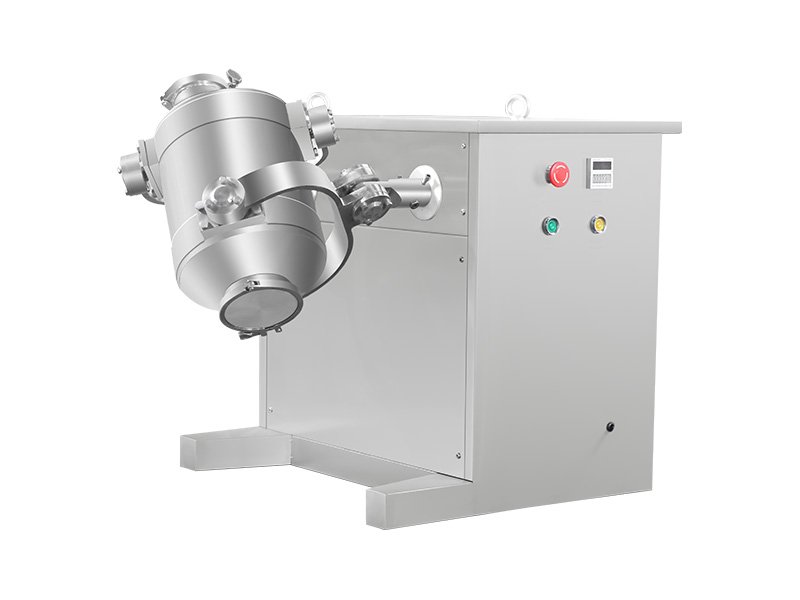
The double cone blender pharmaceutical design consists of two conical sections joined at a central cylinder, mounted on a horizontal rotation axis.
How it works: The tapered geometry encourages powder to flow continuously towards the centre of the vessel and back, producing a gentle rolling and converging mixing action with low mechanical stress on the product. A symmetric vessel rotates end-over-end on a central axis, and material rolls gently from cone to cone in one continuous, even motion.
Key characteristics:
Capacity range: 1L to 5,000L
Optimal fill level: 50–70% of total vessel volume
Mixing mechanism: Diffusive (rolling and converging)
Symmetric interior simplifies cleaning validation
Ideal applications:
Blending pre-formed granules where preserving granule integrity is critical
Cohesive powders and granules that require more support from vessel geometry
Dry powder and granule homogenization for capsule and tablet production
Fragile, heat-sensitive materials
Limitations: The smoother double cone motion provides less blending energy per revolution than a V-blender, making it less effective for fine API powders that carry electrostatic charge or resist uniform distribution through conventional tumbling.
IBC Bin Blender
The IBC bin blender represents a more recent innovation in pharmaceutical mixer machine design, using interchangeable containers (IBC bins) that serve as both mixing vessels and storage/transport containers.
How it works: A single machine can handle multiple bin sizes, enabling flexible batch production. During operation, the entire bin rotates with the machine, ensuring uniform mixing while eliminating material transfer between processes. One bin can be mixing while another is being loaded and a third is being discharged, enabling parallel workflow.
Key characteristics:
Loading factor: Up to 80% of vessel volume
Mixing mechanism: Diffusive (tumbling)
No material transfer between processes required
Fully CIP-capable
Ideal applications:
High-potency active pharmaceutical ingredients (HPAPI) requiring contained processing
Multi-product facilities requiring rapid changeover
GMP-compliant pharmaceutical, food, and nutraceutical production
Operations requiring flexible batch sizes (300L to 2000L on a single machine)
Limitations: Higher initial capital investment compared to V-blenders. The interchangeable bin system requires investment in multiple bins and robust bin management systems.
High Shear Homogenizers for Liquid and Semi-Solid Formulations
While tumble blenders excel at dry powder blending, high shear homogenizers address an entirely different category of pharmaceutical applications—liquid-liquid emulsification, solid-in-liquid dispersion, and the creation of stable suspensions.
How it works: High shear homogenizers employ a rotor-stator principle. A high-speed rotor moving within a stationary stator creates intense mechanical and hydraulic shear, breaking down droplets and particles to create a stable, homogenous mixture. This high-shear mixing mechanism involves intense mechanical energy to break down particles, droplets, or agglomerates.
Key characteristics:
Mixing mechanism: High-shear (rotor-stator)
Processing mode: Batch or inline
Creates stable emulsions and suspensions
Essential for injectables, ophthalmic preparations, and topical formulations
Ideal applications:
Drug suspensions and ophthalmic emulsions
API wet milling
Lipid nanoparticles and parenteral formulations
Stable emulsions such as lotions, creams, and gels
Ensuring active ingredients are evenly distributed within liquid formulations
Cleaning Efficiency Comparison
Cleaning Efficiency Comparison
| Factor | V-Blender | Double Cone Blender | IBC Bin Blender | High Shear Homogenizer |
|---|---|---|---|---|
| Internal geometry complexity | Moderate (V-junction) | Low (symmetric) | Low (simple bin) | High (rotor-stator assembly) |
| Dead zones / residue traps | V-junction contact point | Minimal | Minimal | Rotor-stator gap |
| CIP compatibility | Yes | Yes | Yes | Yes |
| Manual cleaning requirement | Moderate | Low | Low | High (disassembly often required) |
| Cleaning validation complexity | Moderate | Low | Low | High |
| Changeover time | Moderate | Moderate | Fast | Slow |
| Surface accessibility | Moderate | Good | Good | Poor (internal components) |
Production Efficiency Comparison
Key differences in production efficiency:
| Factor | V-Blender | Double Cone Blender | IBC Bin Blender | High Shear Homogenizer |
|---|---|---|---|---|
| Batch frequency | ~1 batch/hour | ~1 batch/hour | 2–3 batches/hour | Variable |
| Changeover time | Moderate | Moderate | Minimal | Significant |
| Material transfer required | Yes | Yes | No | Yes |
| Labor requirement | Medium | Medium | Low | High |
| Energy consumption | Low | Low | Low | High |
Making the Right Choice
The selection of a pharmaceutical mixer machine should be guided by a systematic evaluation of your specific requirements. When choosing a blending machine in pharmaceutical industry applications, consider:
Material characteristics – Particle size, density, flow properties, and cohesiveness
Shear sensitivity – Will your API or granules be damaged by high shear?
Batch size and flexibility – Do you need to process multiple batch sizes?
Cleaning requirements – How frequently will you change products, and what are your validation requirements?
Containment needs – Are you handling HPAPI or high-potency compounds?
Regulatory environment – What are the GMP expectations for your specific application?
The critical insight is not to ask “what is the best mixer?” but rather “which mixing mechanism correctly matches my materials and process objective?”. The choice between a gentle tumble blender for fragile granules and a high-shear homogenizer for a stable emulsion is fundamental to achieving product quality and efficacy.
FAQ
What is the difference between a V-blender and a double cone blender for pharmaceutical powder mixing?
The primary difference lies in the mixing geometry and energy input. A V-blender creates a split-and-recombine action that generates more blending events per rotation, making it more effective for fine API powders and materials that resist uniform distribution. A double cone blender provides a smoother, gentler rolling motion that preserves granule integrity, making it ideal for pre-formed granules and fragile materials. The double cone blender’s symmetric interior also simplifies cleaning validation.
Which pharmaceutical mixer machine is easiest to clean and validate?
IBC bin blenders generally offer the easiest cleaning and validation profile due to their simple bin geometry, absence of internal agitators, and elimination of material transfer between processes. Double cone blenders also score well due to their symmetric internal profile that minimises residual product hold-up. V-blenders require more careful validation at the junction point between the two conical halves, while high shear homogenizers present the greatest cleaning challenges due to their complex rotor-stator assemblies.
When should I choose a high shear homogenizer over a tumble blender?
Choose a high shear homogenizer when your formulation involves liquid-liquid emulsification, solid-in-liquid dispersion, or the creation of stable suspensions and emulsions. High shear homogenizers are essential for injectables, ophthalmic preparations, lipid nanoparticles, and topical formulations such as creams and lotions. Tumble blenders are only suitable for dry powder and granule blending—they cannot process liquid formulations. If your materials are dry powders, a tumble blender (V-blender, double cone, or IBC bin) is the appropriate choice.