


Selecting the correct capsule filling machine size is one of the most fundamental decisions in pharmaceutical and nutraceutical production. The relationship between capsule dimensions and machine compatibility is not merely a matter of physical fit—it affects dosing accuracy, production speed, changeover efficiency, and ultimately, product quality.
Capsule sizes are standardized globally, primarily by the United States Pharmacopeia (USP) and the European Pharmacopoeia (Ph. Eur.). According to the Indian Pharmacopoeia Commission (IPC)—a government authority under India’s Ministry of Health—capsule shells are designated by numbers, with 5 being the smallest and 000 the largest. The USP confirms that hard-shell capsule sizes range from No. 5, the smallest, to No. 000, the largest, noting that “size No. 00 generally is the largest size acceptable to patients”.
This article provides a comprehensive capsule filling machine size chart, explains the physical specifications of each standard size, and offers a practical framework for matching capsule dimensions to the appropriate filling machine model—whether manual, semi-automatic, or fully automatic.
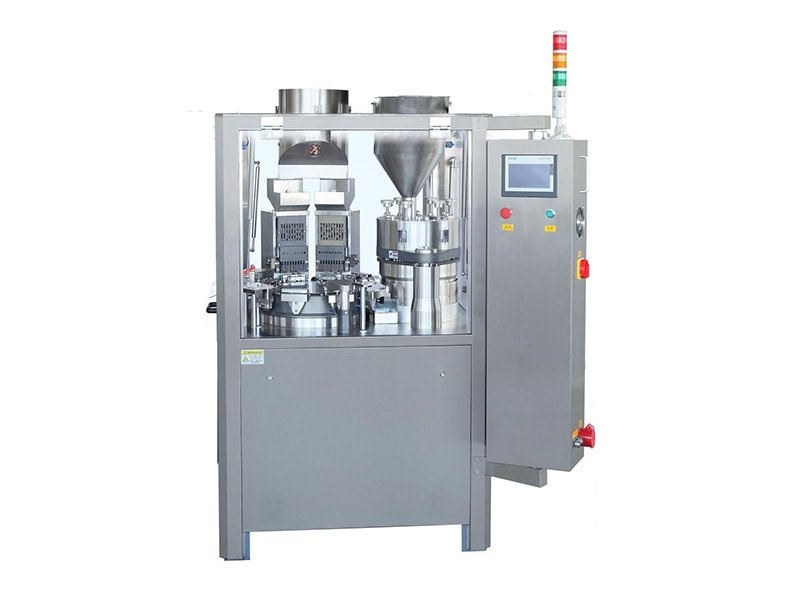
Standard Capsule Filling Machine Size Chart: Dimensions and Capacities
The eight standard capsule sizes—000, 00, 0, 1, 2, 3, 4, and 5—are defined by their physical dimensions and internal volume capacities. Understanding these specifications is the first step in determining the right capsule filling machine size for your application.
Complete Capsule Filling Machine Size Reference Table
The following table provides comprehensive dimensional data for each standard capsule size, compiled from multiple authoritative industry sources:
| Capsule Size | Volume (mL) | Locked Length (mm) | Outer Diameter (mm) | Approx. Capacity at 0.6 g/mL (mg) |
|---|---|---|---|---|
| 000 | 1.37 | 26.1 | 9.91 | 820 |
| 00 | 0.95 | 23.5 | 8.53 | 570 |
| 0 | 0.68 | 21.7 | 7.65 | 408 |
| 1 | 0.50 | 19.4 | 6.91 | 288 |
| 2 | 0.37 | 18.0 | 6.35 | 216 |
| 3 | 0.30 | 15.9 | 5.82 | 162 |
| 4 | 0.21 | 14.3 | 5.31 | 120 |
| 5 | 0.13 | 11.1 | 4.91 | 78 |
Understanding the Capsule Size Numbering System
The numbering system is inversely proportional to size—the smaller the number, the larger the capsule. Size 000 is the largest standard capsule, while size 5 is the smallest. This numbering convention is consistent across gelatin, vegetarian, and enteric-coated capsules.
Key points about capsule dimensions:
Volume capacity determines how much active ingredient or formulation can be filled per capsule
Locked length affects swallowability and patient acceptance
Outer diameter influences machine tooling requirements and changeover complexity
Fill capacity varies significantly with powder density—the table above uses a reference bulk density of 0.6 g/mL
The IPC guidance also notes that capsule dimensions may vary with moisture content, temperature, and humidity—measurement should be made under controlled conditions of 20–25°C and 45–55% relative humidity.
How Capsule Filling Machine Size Affects Machine Selection
The capsule filling machine size you choose directly impacts which machine models you can use, what tooling is required, and how efficiently your production line operates.
The Physical Compatibility Principle
Every capsule filling machine is designed with specific mechanical tolerances that must match the capsule’s outer diameter and length. The machine’s mold cavities, dosing pins, transfer mechanisms, and ejection systems are all engineered to accommodate particular capsule filling machine size ranges.
To change from one capsule size to another on the same machine, operators must replace size-specific tooling sets—including dosator discs or tamping pins, capsule segment plates, and body and cap holders. This means the capsule filling machine size compatibility is not just about whether the capsule fits—it’s about whether the machine has the correct change parts available. The same principle applies downstream: a capsule polisher machine must also be equipped with size-specific polishing brushes and screen inserts to accommodate different capsule dimensions, ensuring that dust removal and surface finishing are effective without damaging the capsules. Failing to account for this can result in inconsistent product appearance or even capsule damage, making size compatibility a consideration that spans the entire production line.
Size Range Compatibility by Machine Type
Different classes of capsule filling machines offer varying degrees of capsule filling machine size flexibility:
Manual capsule fillers typically use size-specific plates that must be ordered for each capsule size. A 100-hole manual filler, for example, is available for capsule sizes 000, 00, 0, 1, 2, 3, 4, and 5—but each plate is size-specific and cannot be used across sizes. Some manual fillers offer more limited ranges, such as 00, 0, or 1 only.
Semi-automatic capsule filling machines generally support a broader range. Many models accommodate capsule sizes from 000# to 5#, with filling heads compatible with different raw materials. Typical semi-automatic machines support 000#, 00L#, 00#, 0L#, 0#, 1#, 2#, 3#, and 4#, while others cover 00, 0, 1, 2, 3, and 4.
Fully automatic capsule filling machines offer the widest compatibility. Most models support all standard sizes from 000 to 5, including gelatin and HPMC capsules. High-end systems can handle all capsule sizes from 000-00el-00-0el-0-1el-1-2el-2-3-4-5 and DBCaps.
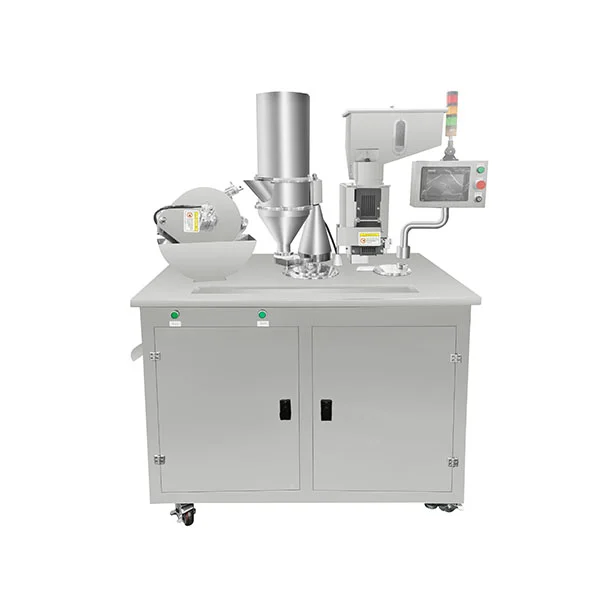
The Impact of Capsule Size on Production Speed
An often-overlooked factor in capsule filling machine size selection is the relationship between capsule size and production speed. Machine output ratings are typically based on the smallest capsules—such as size 2 or 3. Filling larger capsules like size 00 or 000 generally results in lower actual throughput because:
Larger capsules require longer filling and ejection cycles
Powder dosing volumes are higher, requiring more material handling time
The physical size of larger capsules reduces the number of stations or positions available in the machine’s rotary design
For size 00 and 000 capsules, some fully automatic machines can still achieve stable production rates of 120,000–130,000 capsules per hour, but this is typically below the rated maximum for smaller sizes. This size-to-speed correlation extends beyond the filling process itself—a pill counting machine used in downstream packaging exhibits similar behavior, as larger capsules feed more slowly through counting channels and require wider slats or vibratory tracks, reducing overall counting throughput. Consequently, the production bottleneck may shift from filling to counting when processing large-format capsules, making it essential to evaluate speed compatibility across the entire line.
Capsule Filling Machine Size Selection Framework
To select the optimal capsule filling machine size for your operation, follow this systematic approach:
Determine your required fill weight based on your formulation’s active ingredient dose and excipient ratio
Calculate the required fill volume using your powder’s bulk density (fill volume = target weight ÷ bulk density)
Select the capsule size whose volume capacity matches or exceeds your calculated requirement
Verify machine compatibility—confirm that your chosen capsule size falls within the machine’s supported range
Assess changeover requirements—if you run multiple sizes, evaluate changeover time and tooling costs
Consider production speed—larger capsules generally reduce output rates
Additional factors to evaluate:
Whether the machine supports both gelatin and HPMC capsules
The availability of size-specific tooling for your chosen capsule size
The machine’s dosing accuracy at your target fill weight
Integration with downstream equipment such as capsule polishers and packaging lines
Common Capsule Filling Machine Size Configurations
| Machine Type | Typical Capsule Size Range | Change Parts Required | Best For |
|---|---|---|---|
| Manual capsule filler | 000–5 (size-specific plate) | Size-specific plate | R&D, small batches, single-size production |
| Semi-automatic | 000–4 or 00–5 | Mold set, filling heads | Growing brands, multiple SKUs |
| Fully automatic (entry) | 00–5 | Complete tooling set | Mid-volume production |
| Fully automatic (standard) | 000–5 | Complete tooling set | High-volume, multi-size production |
| High-speed automatic | 000–5 (with specialty sizes) | Complete tooling set | Industrial-scale manufacturing |
Conclusion
Understanding capsule filling machine size standards and compatibility is essential for any pharmaceutical or nutraceutical manufacturer. The eight standard sizes—from 000 to 5—each have distinct dimensional specifications that determine not only fill capacity but also machine compatibility, production speed, and changeover complexity.
When selecting a capsule filling machine size, consider your formulation’s volume requirements, patient acceptance factors, and the machine’s supported size range. Remember that larger capsules generally reduce throughput, and changing sizes requires dedicated tooling that represents an additional investment.
By matching your capsule filling machine size to your production needs—rather than simply choosing the largest or smallest option—you can optimize dosing accuracy, production efficiency, and overall equipment ROI.
FAQ
What are the standard capsule sizes available for capsule filling machines?
The eight standard capsule sizes are 000, 00, 0, 1, 2, 3, 4, and 5—from largest to smallest. Size 000 has a volume of 1.37 mL and an outer diameter of 9.91 mm, while size 5 has a volume of 0.13 mL and an outer diameter of 4.91 mm.
Can the same capsule filling machine handle different capsule sizes?
Yes, but changing capsule sizes requires swapping out size-specific tooling—including mold cavities, dosing pins, and transfer components. Some machines feature modular quick-change systems that enable faster transitions.
How does capsule size affect production speed?
Machine output ratings are typically based on the smallest capsules (size 2 or 3). Filling larger capsules like size 00 or 000 generally results in lower actual throughput due to longer filling cycles and higher material handling requirements.