


For anyone entering pharmaceutical manufacturing, the tablet press machine is one of the most important pieces of equipment to understand. It converts prepared powder or granulated material into tablets with controlled shape, weight, thickness, and mechanical strength.
However, beginners often encounter several different terms, including tablet compression machine, pill compression machine, rotary tablet press, and tablet press. These names may describe similar equipment, but they do not always communicate exactly the same thing.
Understanding the terminology first makes the rest of the equipment much easier to follow. A tablet press machine is not simply a device that “pushes powder into a tablet.” It is a controlled mechanical system that combines powder feeding, die filling, precompression, main compression, tablet ejection, and discharge.
This guide explains the basic definition, common industry terminology, operating principle, main components, machine types, production factors, and pharmaceutical manufacturing considerations for beginners.
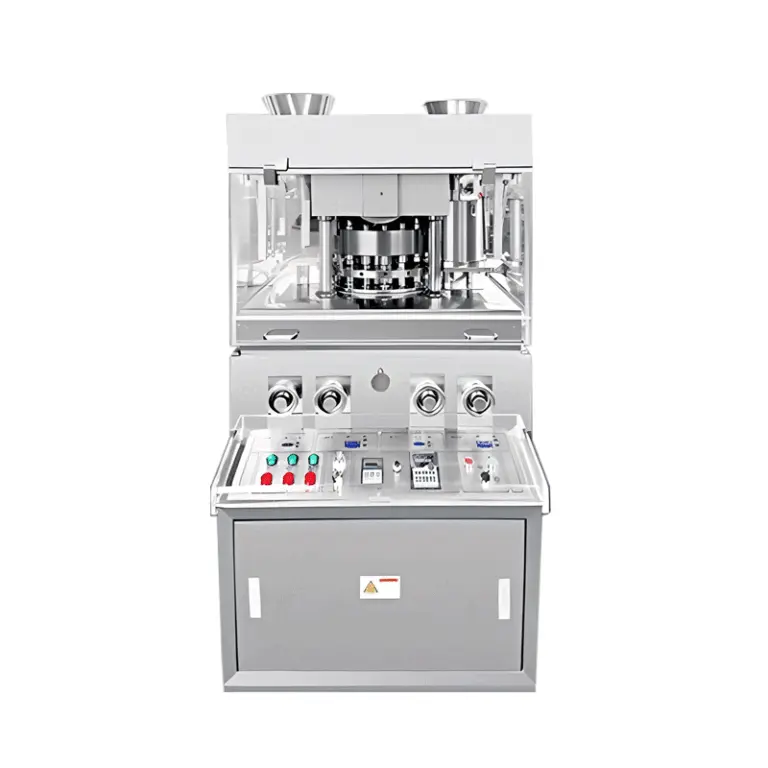
What Is a Tablet Press Machine?
A tablet press machine is pharmaceutical production equipment used to compact a measured quantity of powder or granulated material into a defined tablet form. The material is placed into a die cavity and compressed between upper and lower punches.
In pharmaceutical manufacturing, the tablet press machine normally operates as part of a larger production process. Before compression, raw materials may undergo dispensing, milling, blending, granulation, drying, lubrication, and other preparation steps. After compression, tablets may proceed to dedusting, inspection, coating, packaging, and quality-control operations.
The basic concept is relatively simple:
- Prepared material enters the feeding system.
- A controlled quantity fills the die cavity.
- The upper and lower punches position the material.
- Precompression may remove trapped air and begin consolidation.
- Main compression applies the required force.
- The lower punch rises to eject the formed tablet.
- The tablet moves toward the discharge area.
This sequence explains why a tablet press machine is better understood as a precision compaction system rather than simply a mechanical pressing device.
USP describes pharmaceutical tablet production as a die-compaction process in which a controlled volume of powder is placed into a die and compressed using punches. At industrial scale, rotary presses use multiple punches and dies mounted on a rotating turret.
Tablet Press Machine and the Meaning of “Tablet”
A tablet is a solid pharmaceutical dosage form produced by compaction. Depending on the formulation and intended use, tablets can have different shapes, sizes, release characteristics, and mechanical properties.
The tablet press machine therefore has to do more than create a recognizable shape. The finished product must meet established specifications appropriate to the formulation and dosage form.
Important properties can include:
- Tablet weight
- Thickness
- Hardness or breaking force
- Friability
- Disintegration
- Dissolution
- Appearance
- Content uniformity or dosage-related attributes
USP identifies tablet mechanical strength as an important consideration because tablets must withstand manufacturing, transportation, handling, and use.
What Are the Common Names for a Tablet Press Machine?
The pharmaceutical industry uses several names for compression equipment. Some are technically specific, while others are informal or used for search and purchasing purposes.
A tablet compression machine is one of the most common alternatives to tablet press machine. The two expressions generally refer to equipment that compresses powder or granules into tablets.
Pill compression machine is another common commercial expression. The word “pill” is widely understood in general English, but pharmaceutical professionals more commonly use “tablet” when referring to a specific solid dosage form.
The following table helps beginners distinguish the terminology.
| Common Term | Typical Meaning | Beginner Notes |
|---|---|---|
| Tablet press machine | Equipment used to form tablets by compression | Standard industry terminology |
| Tablet compression machine | Compression equipment for tablet production | Often used interchangeably |
| Pill compression machine | General or commercial term for tablet-forming equipment | Less precise pharmaceutical terminology |
| Tablet press | Short form of tablet press machine | Common in technical discussions |
| Rotary tablet press | A press using a rotating turret with multiple punch-and-die sets | Common for industrial production |
| Single-punch tablet press | Equipment using one primary punch-and-die station | Often associated with laboratory or small-scale work |
The important point is that these terms should not automatically be treated as completely different machines. Equipment specifications, operating principles, configuration, and intended production scale provide more useful information than the name alone.
How Does a Tablet Press Machine Work?
The working principle of a tablet press machine is based on controlled die filling and mechanical compaction.
Prepared powder or granules are first delivered to the feed system. The lower punch creates the available volume inside the die. Material enters the die cavity, and the amount filled depends on factors such as formulation properties, fill depth, machine settings, and feed behavior.
The filled material then moves through the compression section.
Tablet Press Machine Feeding and Die Filling
Consistent die filling is fundamental to tablet production. If the amount of material entering each die varies, tablet weight can also vary.
Powder characteristics influence this stage significantly. Particle size distribution, bulk density, flowability, moisture, granulation quality, and lubrication can all affect feeding behavior.
The tablet press machine must therefore work with a formulation that has suitable physical characteristics for the selected equipment and process.
Tablet Press Machine Precompression
Some tablet press machine configurations include a precompression stage.
Precompression applies an initial force before the main compression event. It can help reduce entrapped air and begin consolidation of the powder bed.
The exact pressure and operating conditions depend on the formulation, tablet dimensions, tooling, and machine design. Precompression is not simply a fixed value that should be applied equally to every product.
Tablet Press Machine Main Compression
During main compression, the upper and lower punches move toward each other and apply substantial force to the material inside the die.
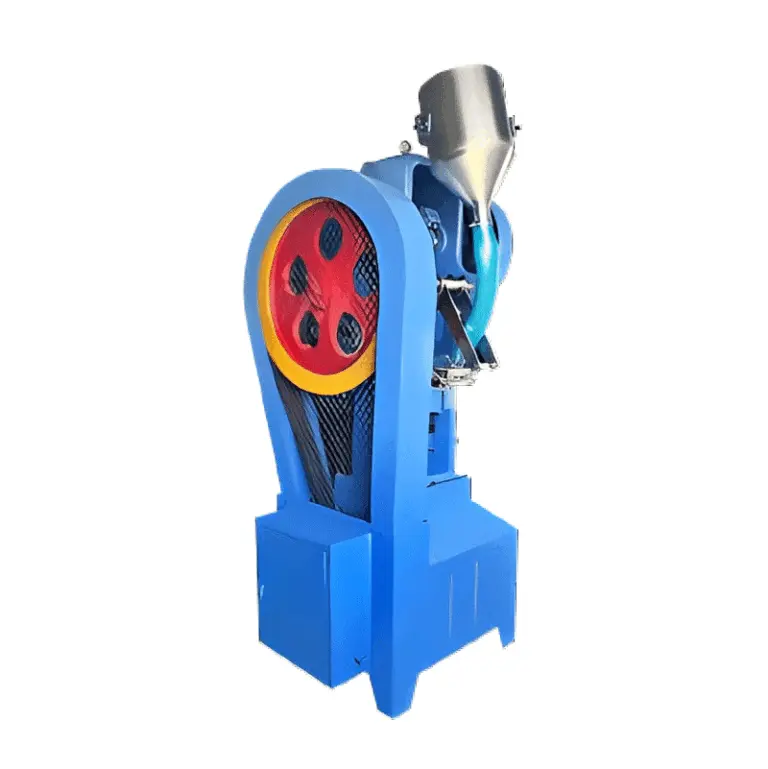
The powder particles rearrange, deform, fracture, and bond depending on their physical and mechanical properties. The result is a compact with a defined geometry and mechanical structure. A single punch tablet press machine demonstrates this basic compression principle clearly on a smaller production scale.
Compression force is important, but it is not the only variable that determines tablet quality.
Factors such as formulation composition, particle characteristics, moisture, lubrication, turret speed, dwell time, fill depth, and tooling condition may also influence the final result.
Tablet Press Machine Ejection and Discharge
After compression, the lower punch moves upward and pushes the tablet toward the upper surface of the die table.
The tablet then enters the discharge area and is transferred to the next processing stage.
A properly designed tablet press machine should support controlled tablet movement while minimizing unnecessary mechanical stress, sticking, picking, chipping, or other defects.
What Are the Main Parts of a Tablet Press Machine?
Understanding the major components provides a useful framework for beginners.
A typical rotary tablet press machine can include:
- Hopper and feeding system
- Feed frame or feeder
- Turret
- Punches
- Dies
- Upper and lower compression rollers
- Precompression rollers
- Cam tracks
- Fill-depth adjustment system
- Compression-force adjustment system
- Tablet ejection mechanism
- Discharge chute
- Drive system
- Control and monitoring system
- Safety guards and interlocks
The punches and dies directly define the tablet geometry. Their dimensions, shape, condition, and compatibility with the formulation are therefore important. After compression, a capsule polisher may be used in other solid dosage production lines to help improve capsule surface cleanliness and appearance.
The turret holds multiple punch-and-die sets and rotates during production. This allows the tablet press machine to perform repeated compression cycles continuously.
FDA inspection guidance identifies tablet presses, punches, and dies among the equipment associated with tablet and capsule manufacturing operations.
What Types of Tablet Press Machine Are Common?
Different production environments require different press configurations.
A single-punch tablet press machine generally produces one tablet at a time through one primary compression station. Its relatively simple operating concept makes this type useful for development, demonstrations, testing, and some small-scale applications.
A rotary tablet press machine uses multiple punch-and-die stations positioned around a rotating turret. As the turret rotates, each station passes through feeding, compression, and ejection stages.
For larger production environments, rotary equipment can provide substantially higher throughput because multiple compression events occur during each turret revolution.
The choice between equipment types depends on the intended application rather than simply the desired maximum output.
| Machine Type | General Application | Main Characteristic |
|---|---|---|
| Single-punch press | Development and small-scale production | Simple structure and operation |
| Rotary press | Industrial production | Multiple punch-and-die stations |
| Laboratory press | Formulation and process studies | Designed for controlled small-scale work |
| High-speed rotary press | Large-scale manufacturing | Higher potential throughput and automation |
What Factors Affect Tablet Press Machine Performance?
A tablet press machine cannot compensate for an unsuitable formulation indefinitely. Stable tablet production depends on the interaction between material properties, tooling, machine settings, and process controls.
Key factors include:
- Formulation flowability and compressibility
- Particle-size distribution and granulation quality
- Moisture content
- Lubrication level
- Die-fill consistency
- Compression force
- Turret speed
- Precompression settings
- Tooling condition
- Equipment cleanliness and maintenance
For example, increasing machine speed may increase production output, but it can also change filling behavior and reduce the time available for compression under certain operating conditions.
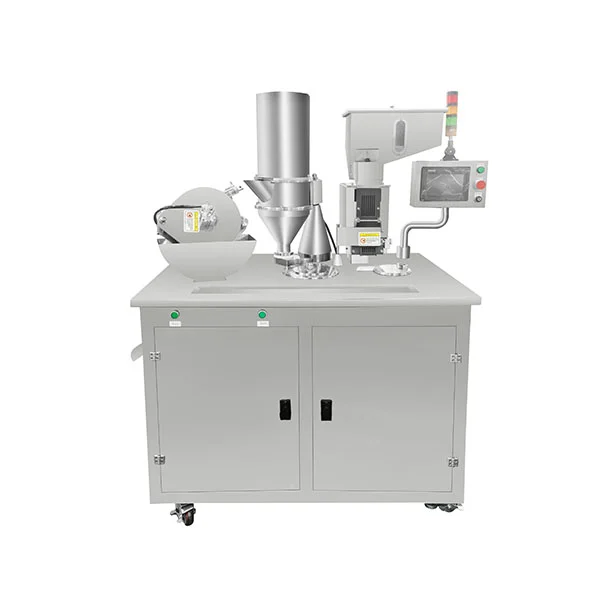
FDA materials note that machine speed and other tablet compression equipment variables can affect tablet weight and manufacturing performance. Similar attention to equipment settings is also important in upstream processes involving a capsule filling machine, where consistent material feeding can influence production stability.
What Quality Controls Are Used With a Tablet Press Machine?
Quality control should be established according to the product, formulation, specifications, and manufacturing process.
Typical in-process checks may include tablet weight, thickness, hardness or breaking force, appearance, and other product-specific characteristics.
The purpose is not simply to test finished tablets. In-process monitoring helps identify changes during production so that appropriate action can be taken before a larger quantity of product is affected.
For a tablet press machine, useful process information can include compression force trends, fill behavior, machine speed, rejection rates, and other equipment parameters.
USP provides dedicated chapters covering tablet compression characterization, breaking force, friability, and compaction behavior.
FAQ
Is a tablet press machine the same as a tablet compression machine?
In most pharmaceutical manufacturing discussions, the two terms describe essentially the same type of equipment. The exact machine configuration should be confirmed from its technical specifications rather than its name alone.
What is the difference between a tablet press machine and a pill compression machine?
They generally refer to the same basic tablet-forming concept. “Pill compression machine” is a broader commercial expression, while “tablet press machine” is more precise for pharmaceutical manufacturing.
Does a tablet press machine determine tablet quality by itself?
No. Tablet quality depends on formulation properties, material preparation, tooling, compression conditions, machine settings, process controls, and downstream handling. The press is an important part of the system, but it is not the entire manufacturing process.