


An industrial tablet press is designed for continuous tablet production in pharmaceutical, nutraceutical, chemical, and food manufacturing. Unlike laboratory equipment, an industrial tablet press focuses on higher production capacity, stable compression, automation, tooling durability, and reliable operation over extended production runs.
For manufacturers moving from formulation development to commercial production, understanding the core features of an industrial tablet press can help with equipment selection and production planning.
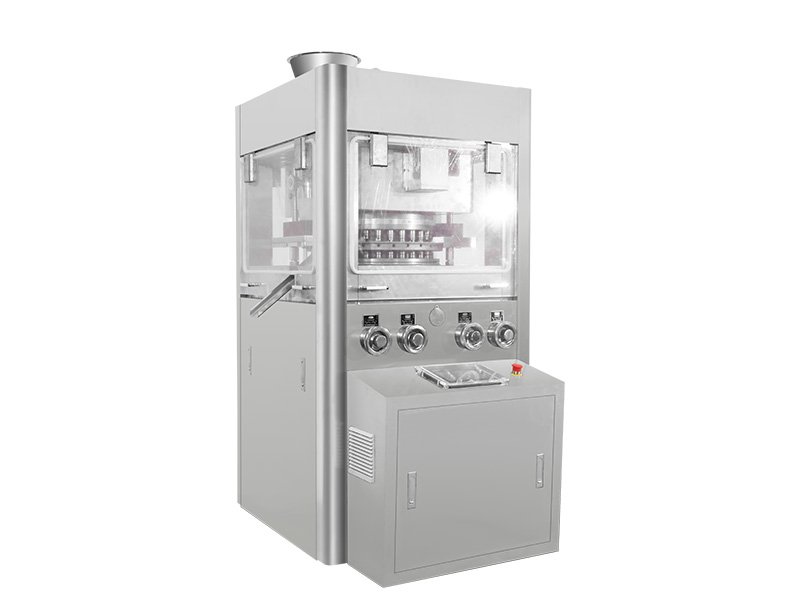
What Is an Industrial Tablet Press?
An industrial tablet press is a mechanical machine that converts powder or granulated material into tablets through controlled filling, pre-compression, main compression, and ejection.
A typical system includes a feeding mechanism, punches and dies, compression stations, turret, drive system, tablet discharge system, control interface, and safety protection. A tablet deduster can also be integrated after the press to remove loose powder from the tablet surface before downstream processing.
The actual configuration depends on tablet size, formulation characteristics, production volume, tooling, and manufacturing requirements. Therefore, an industrial tablet press should be evaluated according to the complete production process rather than machine size alone.
Industrial Tablet Press Production Capacity
Production capacity is one of the most important features of an industrial tablet press. Theoretical output is generally affected by the number of stations, turret speed, and the number of tablets produced per compression cycle.
However, actual production can be lower because of formulation properties, machine adjustments, tooling, cleaning, sampling, and quality-control requirements.
| Factor | Production Impact |
|---|---|
| Number of stations | Determines available compression positions |
| Turret speed | Influences production cycle frequency |
| Formulation | Affects feeding and compression stability |
| Tablet size | Influences tooling and operating conditions |
| Changeover | Affects overall equipment utilization |
For mass production, manufacturers should focus on stable and sustainable output instead of maximum theoretical speed.
A powder tablet press must also provide consistent powder feeding. Poor flowability or unstable die filling can affect both production efficiency and tablet weight consistency.
Industrial Tablet Press Compression Control
Compression control is a core performance feature of an industrial tablet press. In a rotary tablet press machine, powder is compressed between punches inside the die to form tablets with the required weight, thickness, hardness, and appearance.
Many machines use pre-compression and main compression. Pre-compression can help remove air from the powder bed, while main compression provides the primary force for tablet formation.
Key operating parameters may include:
- Fill depth and tablet weight
- Pre-compression force
- Main compression force
- Tablet thickness
- Turret speed
- Ejection conditions
These parameters must be established according to the formulation and tooling. Excessive compression can increase tooling stress or cause defects, while insufficient force may produce weak tablets.
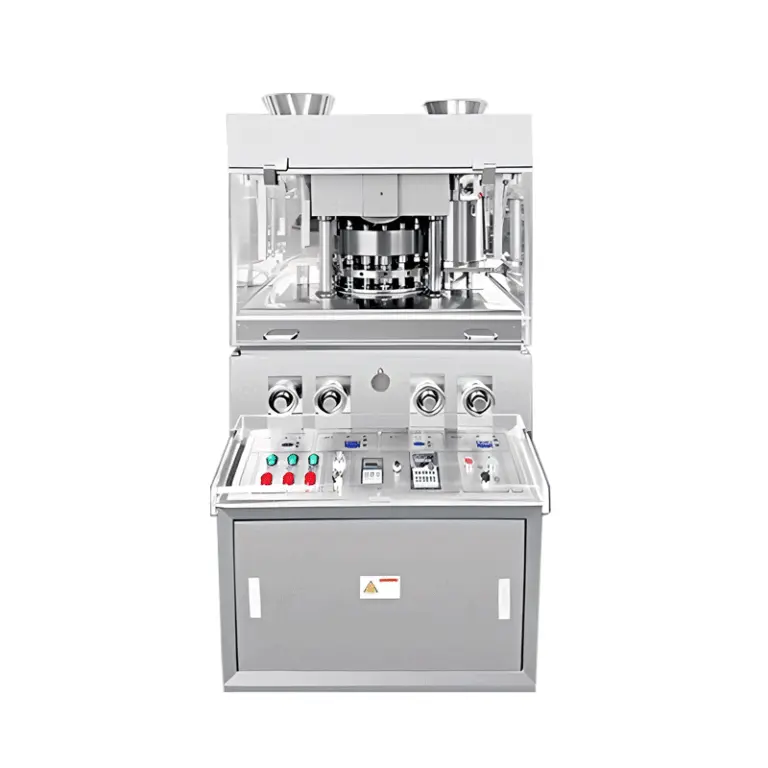
Industrial Tablet Press Automation and Monitoring
Automation is another important difference between industrial and laboratory equipment.
A laboratory tablet compression machine is commonly used for formulation development and small-batch testing, where manual adjustment may be practical. An industrial tablet press generally provides greater automation and monitoring for continuous production.
Typical functions include:
- Production-speed control
- Compression-force monitoring
- Parameter adjustment
- Alarm and fault indication
- Safety interlocking
- Production-status monitoring
These functions can reduce unnecessary manual intervention and help operators identify process changes.
For regulated manufacturing, equipment monitoring should work together with established in-process controls. Depending on the product, manufacturers may monitor tablet weight, thickness, hardness, appearance, and other quality attributes.
Industrial Tablet Press vs Laboratory Equipment
| Feature | Laboratory Model | Industrial Tablet Press |
|---|---|---|
| Main purpose | Development and testing | Commercial production |
| Production scale | Small batches | Medium to high volume |
| Operating period | Short runs | Extended runs |
| Operation | More manual | Greater automation |
| Monitoring | Development-focused | Production-focused |
| Integration | Limited | Production-line integration |
The laboratory stage allows manufacturers to study powder flow, compressibility, tablet strength, and other formulation characteristics. After the process is established, an industrial tablet press provides the capacity and control required for larger-scale production.
Industrial Tablet Press Advantages for Mass Production
The major advantage of an industrial tablet press is the combination of production capacity and process stability.
In commercial manufacturing, the equipment should maintain consistent feeding, compression, ejection, and discharge during extended operation.
Important advantages include:
- Higher practical production capacity
- Stable operation during long production runs
- Automated process monitoring
- Reduced manual intervention
- More consistent tablet production
- Easier integration with downstream equipment
- Improved production scalability
An industrial tablet press can be integrated with tablet dedusting, inspection, metal detection, coating, and packaging equipment. This allows manufacturers to create a more coordinated production line and reduce unnecessary manual handling.
Conclusion
An industrial tablet press combines production capacity, compression control, feeding stability, automation, tooling durability, and process monitoring for commercial tablet manufacturing.
Laboratory equipment remains valuable for development and testing, while industrial equipment is designed for longer runs, higher output, and integration into complete production lines. The right machine should therefore be selected according to formulation characteristics, tablet specifications, production targets, tooling, quality requirements, and overall manufacturing needs.
FAQ
What is an industrial tablet press used for?
It is used to produce tablets from powder or granulated materials at commercial manufacturing scale.
How is an industrial tablet press different from a laboratory machine?
An industrial tablet press generally offers higher production capacity, longer operating capability, greater automation, and better production-line integration.
What affects industrial tablet press output?
Output depends on station number, turret speed, tablet size, formulation properties, tooling, machine settings, and quality-control requirements.