


Choosing the right tablet compression equipment is an important decision for pharmaceutical, nutraceutical, food, and chemical manufacturers. A laboratory machine and an industrial tablet press may use the same basic compression principle, while a tablet press designed for different production scales can vary significantly in structure, capacity, operating conditions, and cost.
A laboratory press is generally developed for formulation trials, process development, research, and small-batch production. An industrial tablet press is designed for continuous manufacturing, higher output, stable feeding, and repeatable production under controlled conditions.
Understanding these differences can help manufacturers avoid selecting equipment based only on maximum tablet output or purchase price. The right choice should consider the development stage, formulation, required capacity, tablet specifications, quality requirements, and expected future production.
This article compares laboratory and industrial tablet presses from several practical perspectives and provides a reference for equipment purchasing decisions.
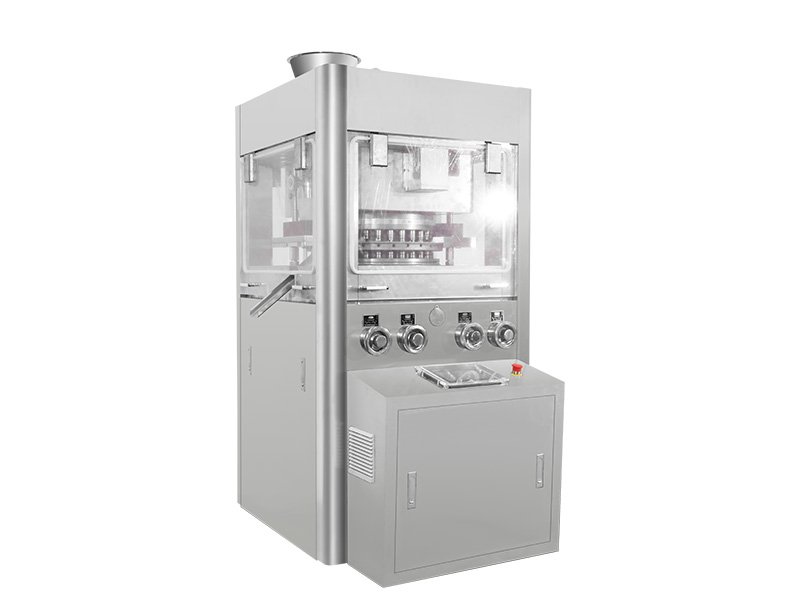
Industrial Tablet Press And Laboratory Tablet Press: Basic Differences
The main difference between a laboratory press and an industrial tablet press is their intended application.
Laboratory equipment normally focuses on flexibility and process development. Manufacturers may use it to test different formulations, compression forces, tooling configurations, and tablet sizes before moving to larger-scale production.
An industrial tablet press focuses more strongly on production efficiency, continuous operation, process stability, and output. Its structure is generally designed to support longer operating periods and higher mechanical loads.
A tablet press machine used in a laboratory may have a relatively compact structure and lower material consumption. In contrast, industrial equipment usually requires a larger feeding system, stronger mechanical components, more comprehensive control functions, and easier integration with upstream and downstream equipment.
| Comparison | Laboratory Press | Industrial Tablet Press |
|---|---|---|
| Main purpose | Research and development | Commercial production |
| Production scale | Small | Medium to high |
| Equipment size | Compact | Larger |
| Operation | Intermittent or short runs | Continuous production |
| Formulation testing | High flexibility | Production-oriented |
| Automation | Basic to advanced | Usually higher |
| Maintenance | Relatively simple | More comprehensive |
| Investment | Generally lower | Generally higher |
Industrial Tablet Press Capacity And Production Structure
Capacity is one of the clearest differences between laboratory and industrial equipment.
A laboratory press is normally not selected primarily for maximum hourly production. Its value comes from allowing manufacturers to produce enough samples for formulation evaluation, testing, and process development.
An industrial tablet press, however, is expected to provide stable output over extended production periods. Theoretical capacity is affected by factors such as the number of stations, turret speed, number of compression cycles, and tooling configuration. When the tablets move to downstream processes such as a tablet coating machine, stable output from the compression stage can also help maintain a more consistent overall production flow.
Actual production capacity can be lower than the theoretical value because of feeding adjustments, sampling, cleaning, tooling changes, rejected tablets, maintenance, and other production activities.
When comparing equipment capacity, manufacturers should therefore consider:
- Theoretical tablets per hour
- Expected effective production time
- Formulation flowability and compressibility
- Tablet size and weight
- Number of stations
- Turret operating speed
- Frequency of tooling or product changes
A high theoretical output does not automatically mean that the machine will deliver the same output in normal production.
Industrial Tablet Press Structure And Mechanical Design
The mechanical structure also changes as equipment moves from laboratory development to industrial manufacturing.
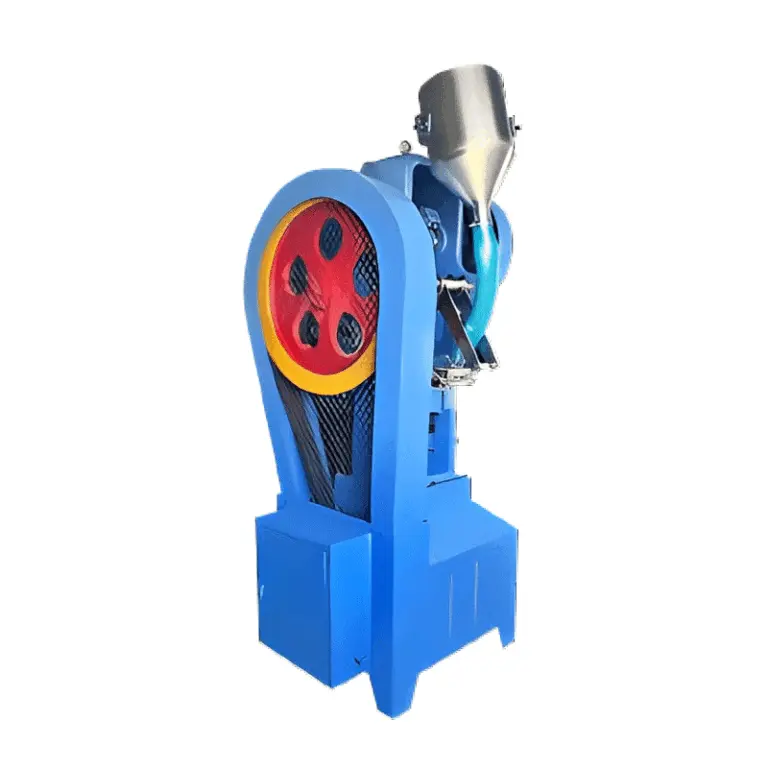
A laboratory machine generally has a compact design because it handles smaller quantities of material and shorter operating cycles. A single punch tablet press machine is one example of equipment commonly suited to small-scale testing, formulation development, and parameter adjustment.
An industrial tablet press normally requires stronger structural components because the equipment must withstand repeated compression cycles at higher production rates. The feeding, compression, lubrication, transmission, and discharge systems are commonly designed around continuous operation.
The compression system is particularly important. Stable movement of punches and dies helps maintain consistent compression conditions. The feeding system must also provide reliable powder filling because unstable die filling can contribute to tablet weight variation.
For industrial applications, equipment structure should also support cleaning, inspection, maintenance, and safe operation. These factors become increasingly important when the machine is integrated into a larger manufacturing line.
Industrial Tablet Press Precision And Process Control
Precision should not be considered only as a mechanical specification. Tablet quality depends on the interaction between formulation properties, feeding, compression, tooling, machine speed, and process control.
Laboratory equipment can provide useful control during formulation development because operators can test different compression conditions using relatively small quantities of material. This allows development teams to study tablet hardness, thickness, weight, appearance, and disintegration behavior.
An industrial tablet press must maintain these parameters consistently across longer production runs.
For example, changes in powder flow may affect die filling and tablet weight. Compression-force variation may influence tablet hardness and thickness. Excessive machine speed may reduce the time available for stable filling or increase the visibility of feeding problems.
A suitable industrial process therefore requires established operating ranges rather than simply selecting a machine with the highest available speed.
Industrial Tablet Press Cost And Total Investment
Purchase price is another important difference.
Laboratory equipment usually requires less initial investment because of its smaller production capacity and simpler overall structure. It can be suitable for companies that are still developing formulations or evaluating whether a product is commercially viable. When planning future production equipment, manufacturers should also consider downstream units such as a tablet deduster, as these additional systems can affect the overall equipment investment and production-line configuration.
The cost of an industrial tablet press is generally higher because the equipment may include a larger compression system, higher-capacity feeding components, automated controls, safety systems, and other production-oriented features.
However, purchase price should not be the only cost considered.
For an industrial tablet press, the total cost of ownership may include:
- Installation and commissioning
- Tooling and spare parts
- Preventive maintenance
- Cleaning and changeover
- Operator training
- Electricity and utilities
- Production downtime
- Validation and documentation
- Integration with other equipment
A lower initial price may not necessarily result in lower long-term production costs.
Industrial Tablet Press And Powder Tablet Press Application
The formulation itself is an important factor when comparing equipment.
A powder tablet press must handle materials with appropriate flowability, particle-size distribution, moisture content, density, and compressibility. These characteristics can vary considerably between pharmaceutical ingredients, nutritional powders, excipients, and other materials.
During laboratory development, manufacturers can evaluate whether a formulation can be compressed successfully before selecting production-scale equipment.
For example, a formulation may show acceptable tablet quality at laboratory scale but require additional granulation, lubrication, or feeding optimization before being transferred to an industrial tablet press.
Scale-up should therefore consider both formulation behavior and equipment differences. The compression process cannot always be transferred directly by simply increasing machine speed.
Industrial Tablet Press Precision And Quality Requirements
Quality control becomes increasingly important as production volume increases.
Laboratory batches are usually produced for development and testing, so operators can closely observe individual process conditions. Industrial manufacturing requires more systematic monitoring because thousands or millions of tablets may be produced during a production campaign.
Typical tablet quality attributes may include:
- Tablet weight
- Thickness
- Hardness
- Friability
- Disintegration
- Dissolution, where applicable
- Appearance and physical defects
The exact testing program depends on the product, formulation, regulatory requirements, and established specifications.
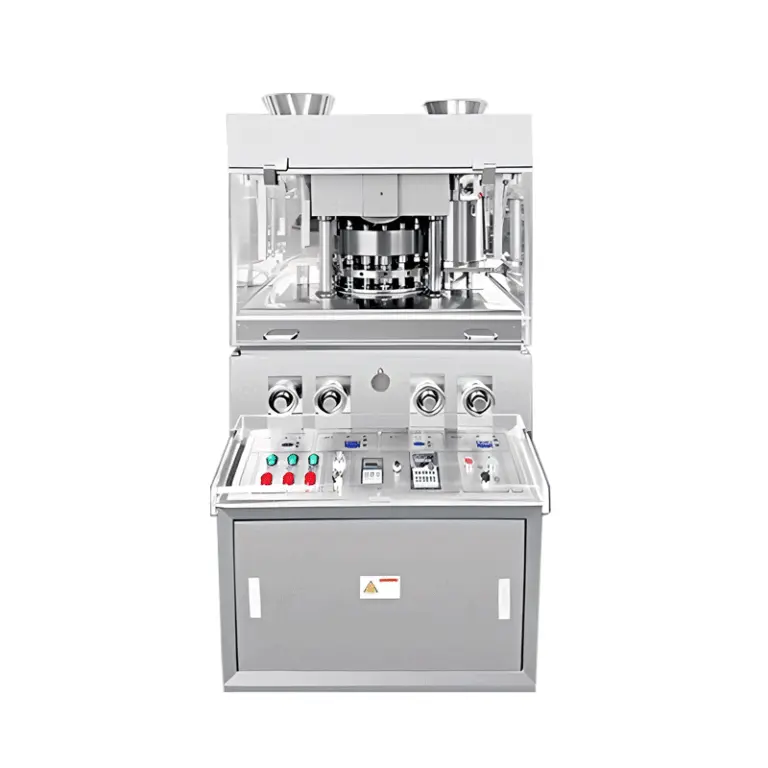
For an industrial tablet press, in-process controls should be designed to identify changes before they result in significant quantities of out-of-specification product. This is particularly important when a rotary tablet press machine is used for continuous production, where changes in feeding, compression force, or machine speed may affect tablet quality across multiple compression cycles.
Industrial Tablet Press Vs Laboratory Press: Cost And Capacity Balance
There is no universal production scale at which a manufacturer must change from laboratory equipment to an industrial tablet press. The decision depends on formulation development, production volume, available facility space, quality requirements, and business plans.
A laboratory press may be sufficient when the main objective is formulation screening, process research, or small-scale testing. Its lower material consumption and compact design can be useful during early development.
An industrial tablet press becomes more relevant when the production process requires higher throughput, longer operating periods, stronger automation, and consistent output.
The most useful comparison is therefore not simply laboratory versus industrial. Manufacturers should compare the equipment against their actual production requirements.
| Purchasing Factor | Laboratory Equipment | Industrial Equipment |
|---|---|---|
| Development work | Strong focus | Limited focus |
| Commercial output | Limited | Primary purpose |
| Flexibility | Usually high | Depends on configuration |
| Continuous operation | Limited | Stronger capability |
| Initial investment | Lower | Higher |
| Operating scale | Small batches | Production batches |
| Future expansion | May require replacement | Better suited to capacity growth |
Industrial Tablet Press: Key Takeaways For Buyers
When selecting tablet compression equipment, manufacturers should evaluate the entire process rather than focusing on a single specification.
An industrial tablet press should be assessed according to production capacity, mechanical structure, feeding stability, compression control, tooling compatibility, cleaning, maintenance, and total ownership cost.
Laboratory equipment remains valuable because it supports formulation development and process understanding before commercial scale-up. Results obtained during development can provide important information for designing the later production process.
The transition from laboratory to industrial production should be based on demonstrated process requirements, not simply on the assumption that larger equipment is always better.
For most purchasing projects, the following principles provide a useful starting point:
- Match machine scale with actual production demand.
- Evaluate effective capacity instead of only theoretical output.
- Confirm compatibility with the intended formulation and tooling.
- Consider cleaning, maintenance, and changeover requirements.
- Allow reasonable capacity for future product development.
A well-matched industrial tablet press can support stable production, but equipment selection should always be combined with appropriate formulation development, process control, quality testing, and operating procedures.
FAQ
What is the main difference between a laboratory press and an industrial tablet press?
A laboratory press is mainly used for formulation development and small-scale testing, while an industrial tablet press is designed for higher-volume and longer-duration commercial production.
Is an industrial tablet press always more precise?
Not necessarily. Precision depends on machine design, formulation properties, tooling, feeding stability, compression control, and operating conditions. Industrial equipment is generally designed for consistent performance during longer production runs.
How should manufacturers calculate tablet press capacity?
Capacity should be evaluated from theoretical output and actual effective production time. Station number, turret speed, tablet configuration, setup, cleaning, sampling, rejects, and maintenance should all be considered.